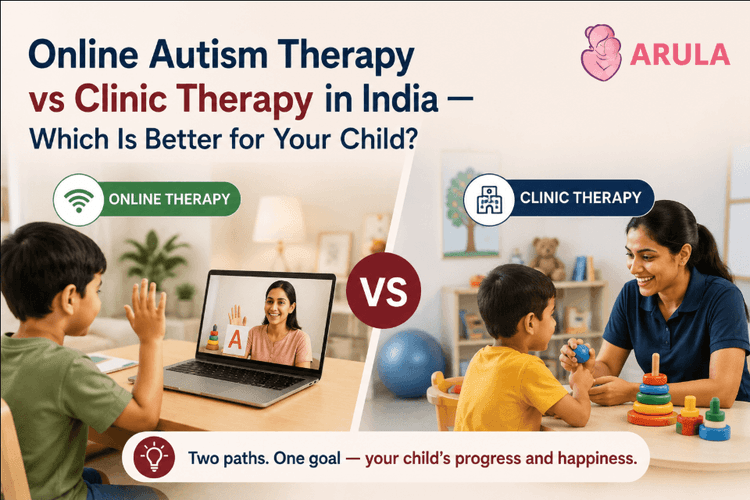
Online Autism Therapy vs Clinic Therapy in India -Which Is Better for Your Child?
Online and clinic-based autism therapy both offer valuable benefits, but there is no one-size-fits-all answer.
AF
ARULA for Autism
· 7 min read
What Is Therapy for Autism?
Therapy for autism spectrum disorder (ASD) refers to structured, evidence-based support provided by trained professionals, such as occupational therapists, speech-language therapists, behavior therapists, and psychologists to help children build skills in:
Communication and language
Emotional regulation and self-awareness
Sensory processing and motor development
Daily participation and adaptive functioning
In India today, these therapeutic services are increasingly available in two forms: clinic-based (in-person) therapy and online (telehealth) therapy.
As a parent, you may be wondering which path is right for your child. The answer, as with most things in child development, is not one-size-fits-all and the goal of this blog is to help you understand both options clearly, without guilt or pressure.
Understanding Autism Therapy in the Indian Context
India is home to a large and growing population of children on the autism spectrum. Awareness has improved significantly over the past decade. However, significant challenges remain:
Expertise in autism diagnosis and therapy is still largely concentrated in urban centres like Mumbai, Delhi, Bengaluru, Chennai, and a handful of other cities
Families in smaller cities, towns, and rural areas often have little to no access to qualified specialists nearby
Cultural factors, language barriers, and financial costs make consistent in-person therapy difficult if not impossible for many households
The frequency of sessions recommended by early intervention research, often multiple times per week can quickly become logistically and financially unsustainable
This is the landscape in which online therapy has emerged is not merely as a convenience, but for many Indian families, as a genuine lifeline.At the same time, clinic-based therapy continues to offer distinct and meaningful advantages that cannot always be replicated on a screen.
What ARULA Observes
Within the ARULA framework, therapy is understood through the lens of regulation, participation, predictability, and emotional safety.
When evaluating any therapeutic setting, the central question is not simply "Which is more effective?" but rather: Which setting allows this particular child to feel safe, regulated, and ready to engage?
The environment in which therapy takes place its sensory qualities, its familiarity, its emotional tone is not just a backdrop to the work; it is part of the work
Both online and clinic-based settings can support meaningful developmental progress when thoughtfully implemented
Neither is inherently superior what matters is the fit between the child, the family, and the approach
Understanding the Two Settings
Clinic-Based Therapy
Your child visits a specialist centre and works directly with trained therapists in a structured, equipped environment.
Hands-on sensory support: Clinics use specialised equipment (swings, balance boards, tactile tools) for Sensory Integration Therapy a play-based approach that can only be delivered in person by a trained occupational therapist.
Real-time attunement: A therapist in the room picks up on subtle shifts in posture, breath, and behaviour that a screen can miss supporting co-regulation moment to moment.
Peer interaction: Group sessions (social skills, play, communication) give children supported practice with real peers hard to replicate online.
Practical challenges: Travel costs, long waiting lists, and limited availability outside major cities make consistent clinic-based therapy difficult for many Indian families.
Online (Telehealth) Therapy
Sessions are delivered via video call, combining direct interaction with the child and live parent coaching. A 2024 systematic review (Reyes et al., Neuroscience & Biobehavioral Reviews) found online autism interventions comparable in effectiveness to in-person therapy at lower cost to families.
Access for all families: Especially for those outside major cities, online therapy is often the only realistic path to qualified support removing the geography barrier entirely.
Home comfort: Children often arrive at online sessions already calm. Familiar surroundings reduce sensory and emotional load, and skills practised in session can be applied immediately in everyday life.
Consistency: Fewer logistical hurdles mean families can maintain a regular schedule and consistency is one of the strongest drivers of developmental progress.
Rapport online is real: Therapists build genuine connection with children through familiar routines, warm presence, and responsive attunement — the same principles that create trust in any setting.
Why the Choice of Setting Matters Developmentally
Parents are sometimes told that "more therapy is better" or that one modality is definitively superior. The developmental reality is more nuanced:
What matters most is not the number of therapy hours, but whether the child feels safe, understood, and ready to engage
It matters whether the parent feels empowered informed, confident, and genuinely supported
It matters whether the family can sustain therapy in a way that is consistent over time not just intensive for a short period
How ARULA Methods Support This Area
Within the ARULA framework, the question of online versus clinic-based therapy is approached through careful attention to each child's developmental profile, sensory needs, regulation capacity, and family context:
ARULA recognises that participation is not just an outcome of therapy it is the medium through which development happens
Whether in a clinic sensory gym or a home-based activity guided by a coached parent, the therapist is always asking: Is this child genuinely engaged? Is their nervous system in a state that supports learning?
The approach to co-regulation helping children settle their nervous systems through the presence of a calm, attuned adult is effectively delivered in both settings
ARULA's emphasis on the therapist-parent relationship means online therapy is never just about what happens during the session it is about building a parent's capacity, confidence, and understanding, so that every interaction with their child becomes an opportunity for growth
The goal is never to prescribe a single format, but to understand where this child, in this family, at this point in their development, is most likely to feel safe, supported, and ready to grow.
Conclusion
There is no single answer to whether online or clinic-based therapy is better for your child. Both pathways, when thoughtfully implemented, can support meaningful progress in communication, regulation, participation, and daily functioning.
For many Indian families particularly those outside major cities online therapy represents a genuinely effective and empowering option, not a compromise
For children with significant sensory or motor needs, clinic-based therapy may offer hands-on support that online sessions cannot replicate
Many families benefit most from a blended approach: consistent online sessions for parent coaching and everyday skill-building, complemented by periodic clinic-based input for specialised assessment or intervention
What matters most is not where the therapy happens, but whether your child feels understood, whether you feel supported, and whether the approach is grounded in a genuine understanding of your child's developmental needs
Progress, in any setting, is gradual and meaningful.
References
Bajracharya, L., Suman, P., & Mushtaq, I. (2024). Comparative analysis of effectiveness of online versus offline parent-mediated therapeutic intervention in preschool children with autism spectrum disorder. International Journal of Clinical Pediatrics. https://doi.org/10.14740/ijcp538
de Nocker, Y. L., & Toolan, C. K. (2021). Using telehealth to provide interventions for children with ASD: A systematic review. Review Journal of Autism and Developmental Disorders. https://doi.org/10.1007/s40489-021-00278-3
Ellison, K. S., et al. (2023). Telehealth-delivered supports for daily living skills for autistic children: A systematic review. Review Journal of Autism and Developmental Disorders. https://doi.org/10.1007/s40489-023-00389-z
Reyes, M., et al. (2024). Effectiveness, implementation settings, and research priorities of telemedicine-delivered interventions for children and adolescents with autism spectrum disorder: A systematic review. Neuroscience & Biobehavioral Reviews. https://doi.org/10.1016/j.neubiorev.2024.105757
Meta-analysis of effectiveness of parent-mediated telehealth interventions in children with autism spectrum disorder. (2023). Research in Autism Spectrum Disorders. https://doi.org/10.1016/j.rasd.2023.102167
Unraveling the spectrum: A comprehensive review of autism spectrum disorder in India. (2024). Cureus, 16(6), e62753. https://doi.org/10.7759/cureus.62753
Sensory integration therapy versus usual care for sensory processing difficulties in autism spectrum disorder in children: Study protocol for a pragmatic randomised controlled trial. (2019). Trials. https://doi.org/10.1186/s13063-019-3205-y
ARULA's Brain Gymming Exercises: Turning Everyday Play into Opportunities for Brain Development
ARULA's Brain Gymming exercises can create meaningful learning opportunities for autistic children, supporting attention, working memory, inhibitory control, cognitive flexibility, motor coordination, and social communication. Through child-centred activities and parent-mediated approaches, familiar routines can encourage learning, communication, independence, and participation in daily life.
Every Child Deserves
The Opportunity To Thrive.
Every child has potential. Sometimes they simply need someone who believes in them deeply enough to help it emerge. Take the first step today.