The Importance of Pretend Play: Developing Cognitive, Emotional and Social Growth
Pretend play helps children build language, emotional understanding, flexible thinking, and social connection, and it gives neurodivergent children a low-pressure way to practice real-life skills at their own pace. At ARULA, it is woven into home-based, parent-involved intervention, starting from each child's interests and developmental profile and building step by step.
AF
ARULA for Autism
· 7 min read
What is Pretend Play?
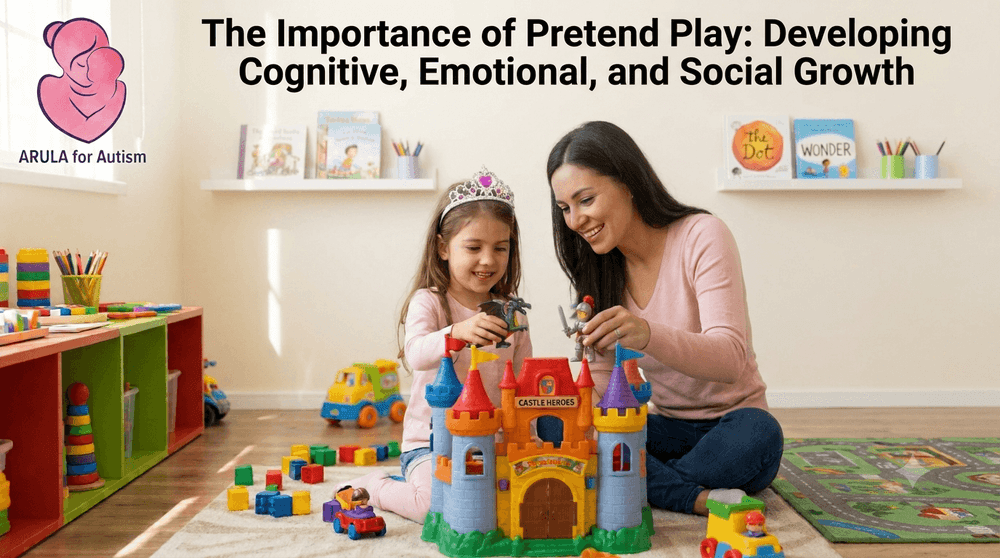
Have you ever watched a child turn a cardboard box into a spaceship, feed an imaginary meal to a teddy bear, or use a banana as a telephone? What may appear to be simple childhood fun is actually a meaningful way of exploring the world, understanding everyday experiences, and making sense of relationships.
Pretend play, also known as symbolic play or imaginative play, occurs when children use objects, actions, or ideas to represent something beyond their actual function. A banana becomes a telephone, a blanket becomes a superhero's cape, or a child imagines becoming a doctor, parent, teacher, or shopkeeper (Weisberg, 2015).
Through these imaginary situations, children recreate familiar experiences, experiment with new possibilities, and gradually develop an understanding of how people, objects, and everyday situations are connected. Pretend play also provides opportunities to express thoughts and feelings that children may not yet have the words to communicate.
How Pretend Play Develops
Pretend play does not emerge all at once. It develops gradually as children begin to imitate familiar activities, use objects symbolically, and create increasingly elaborate imaginary situations. Each stage offers new opportunities for exploration, communication, and learning (Lillard et al., 2013).
Early pretend actions: Toddlers begin by imitating familiar everyday activities, such as pretending to drink from an empty cup, talking on a toy telephone, or feeding a doll.
Object substitution: Children gradually learn to use one object to represent another. For example, a block may become a car, a stick may become a magic wand, or a cardboard box may become a house.
Role-play: Children begin taking on familiar roles, such as a doctor, teacher, parent, or shopkeeper. They imitate actions and interactions they observe in their surroundings.
Imaginary scenarios and storytelling: Play becomes more elaborate as children connect different actions, characters, and events to create simple stories and imaginary situations.
Collaborative pretend play: Children increasingly involve others in their imaginary worlds, sharing roles, responding to ideas, and building stories together.
Each of these stages involves an important cognitive process: the child begins to hold two representations in mind simultaneously. For example, they know that a banana is actually a fruit, but during play, they can also treat it as a telephone. This ability to understand that something can represent something else is an important aspect of symbolic thinking. Researchers have also connected early pretend play with the development of children's understanding of other minds, particularly their ability to distinguish between reality and representation (Leslie, 1987).
Why Pretend Play Matters
Play is increasingly recognised as an essential component of healthy early childhood development, providing children with opportunities to learn, explore, communicate, and make sense of their surroundings (Yogman et al., 2018). Pretend play, in particular, allows children to move beyond the immediate reality of their environment and explore different situations through imagination. Whether they are pretending to cook, looking after a doll, running a classroom, or playing the role of a doctor, these experiences create meaningful opportunities to practise several developmental skills.
Through pretend play, children can:
Develop language and communication: Practise new words, describe actions, narrate experiences, negotiate roles, and create simple stories. Even when a child uses gestures, sounds, or a few words, these can become meaningful opportunities for communication.
Explore and understand emotions: Express feelings through imaginary characters, comfort a doll, pretend to be brave, or recreate familiar emotional situations in a safe and comfortable setting.
Strengthen flexible thinking and problem-solving: Experiment with different ideas, adapt to changes in play, find alternative uses for everyday objects, and develop simple solutions to imaginary problems.
Build social understanding: Practise turn-taking, cooperation, sharing ideas, responding to others, and participating in shared activities.
Develop perspective-taking: Gradually explore how different characters may think, feel, want, or respond differently in the same situation.
Encourage creativity and imagination: Transform familiar objects and everyday experiences into new possibilities, allowing children to explore ideas without the pressure of producing a particular outcome.
How Pretend Play Can Help Neurodivergent Children
Neurodivergent children, including those who are autistic or have other developmental differences, often learn best through experiences that are meaningful, relaxed, and built around their individual interests. Pretend play offers exactly this. Unlike structured learning activities, it does not demand a particular response or have a fixed right or wrong answer. Instead, it creates a gentle, pressure-free space where children can explore ideas, express themselves, experiment with different roles, and engage with the world at their own pace.
When a child pretends to cook a meal, runs a toy shop, takes care of a doll, or imagines being a doctor, they are doing much more than simply playing. They are practising everyday communication, understanding social roles, developing imagination, and learning to make connections between objects, actions, and experiences. These seemingly simple interactions provide opportunities to develop language, problem-solving, emotional understanding, joint attention, turn-taking, and flexible thinking.
Pretend play also allows parents to become active participants in their child's learning without making the experience feel like therapy or instruction. By following the child's interests, introducing new ideas, modelling simple language, and responding to their attempts to communicate, parents can gradually expand the child's play and learning experiences. It can be practised in several ways:
A low-pressure way to communicate. Play gives children a reason to use gestures, sounds, words, or sentences without the pressure of “performing” language.
A safe space to rehearse real life. Pretending to go to the doctor, a birthday party, or school lets children practise situations that may feel unpredictable, at their own pace.
Support for emotional understanding. Acting out feelings through toys and characters can make emotions easier to name, talk about, and cope with.
Practice in flexibility. Moving from a real object to an imagined one, and from one idea to another, gently builds flexible thinking.
A bridge to shared attention and connection. Play with a trusted adult creates natural moments of turn-taking, eye gaze, and joint attention, which are skills linked to later social communication (Kasari et al., 2006).
How ARULA Applies Pretend Play
At ARULA for Autism, play is not treated as a break from therapy. It is part of how development is supported. ARULA is a home-based, holistic developmental intervention programme, and this shapes how pretend play is used in a few ways:
Starting where the child is. Play goals are set according to each child’s developmental profile, interests, and preferred play style, rather than a fixed checklist.
Using the home as the setting. Familiar rooms, routines, and everyday objects such as kitchen items, cloths, and soft toys become the props. Skills practised in a real environment are more likely to carry over into daily life.
Involving parents as play partners. Parents and caregivers are guided to join in, follow the child’s lead, and expand the play, so that learning continues well beyond therapy sessions.
Linking play to communication. Pretend routines such as feeding a doll, a shop game, or a doctor visit become natural chances to build language, requesting, turn-taking, and emotional expression.
Building step by step. Play moves gradually from simple, familiar actions towards more imaginative and shared scenes, in line with the child’s readiness.
Conclusion
Pretend play is far more than a pastime. It supports communication, emotional understanding, and social connection. For every child, including those who play differently, meeting them where they are can open the door to meaningful shared experiences.
The aim is not to make a child “play the right way.” It is to help each child enjoy play, connect with the people around them, and grow in confidence.
References
Jarrold, C. (2003). A review of research into pretend play in autism. Autism, 7(4), 379–390. https://doi.org/10.1177/1362361303007004004
Kasari, C., Freeman, S., & Paparella, T. (2006). Joint attention and symbolic play in young children with autism: A randomized controlled intervention study. Journal of Child Psychology and Psychiatry, 47(6), 611–620. https://doi.org/10.1111/j.1469-7610.2005.01567.x
Kasari, C., Gulsrud, A., Freeman, S., Paparella, T., & Hellemann, G. (2012). Longitudinal follow-up of children with autism receiving targeted interventions on joint attention and play. Journal of the American Academy of Child & Adolescent Psychiatry, 51(5), 487–495. https://doi.org/10.1016/j.jaac.2012.02.019
Leslie, A. M. (1987). Pretense and representation: The origins of “theory of mind.” Psychological Review, 94(4), 412–426. https://doi.org/10.1037/0033-295X.94.4.412
Lillard, A. S., Lerner, M. D., Hopkins, E. J., Dore, R. A., Smith, E. D., & Palmquist, C. M. (2013). The impact of pretend play on children’s development: A review of the evidence. Psychological Bulletin, 139(1), 1–34. https://doi.org/10.1037/a0029321
Weisberg, D. S. (2015). Pretend play. Wiley Interdisciplinary Reviews: Cognitive Science, 6(3), 249–261. https://doi.org/10.1002/wcs.1341
Yogman, M., Garner, A., Hutchinson, J., Hirsh-Pasek, K., & Golinkoff, R. M. (2018). The power of play: A pediatric role in enhancing development in young children. Pediatrics, 142(3), e20182058. https://doi.org/10.1542/peds.2018-2058
ARULA for Autism·
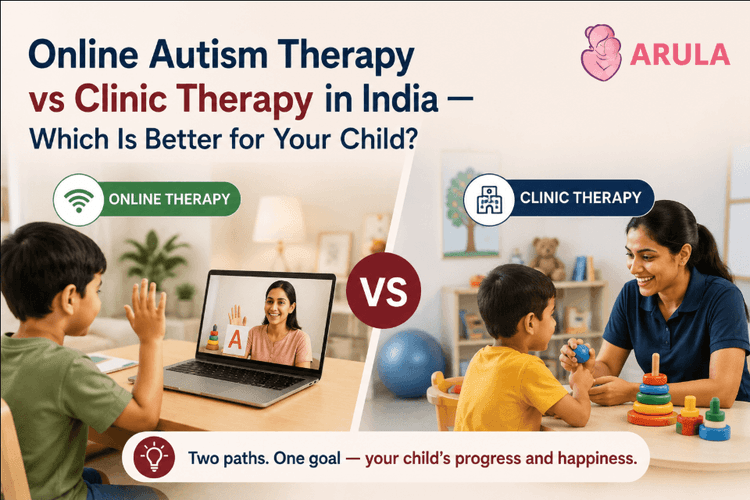
Online Autism Therapy vs Clinic Therapy in India -Which Is Better for Your Child?
Online and clinic-based autism therapy both offer valuable benefits, but there is no one-size-fits-all answer.
Every Child Deserves
The Opportunity To Thrive.
Every child has potential. Sometimes they simply need someone who believes in them deeply enough to help it emerge. Take the first step today.