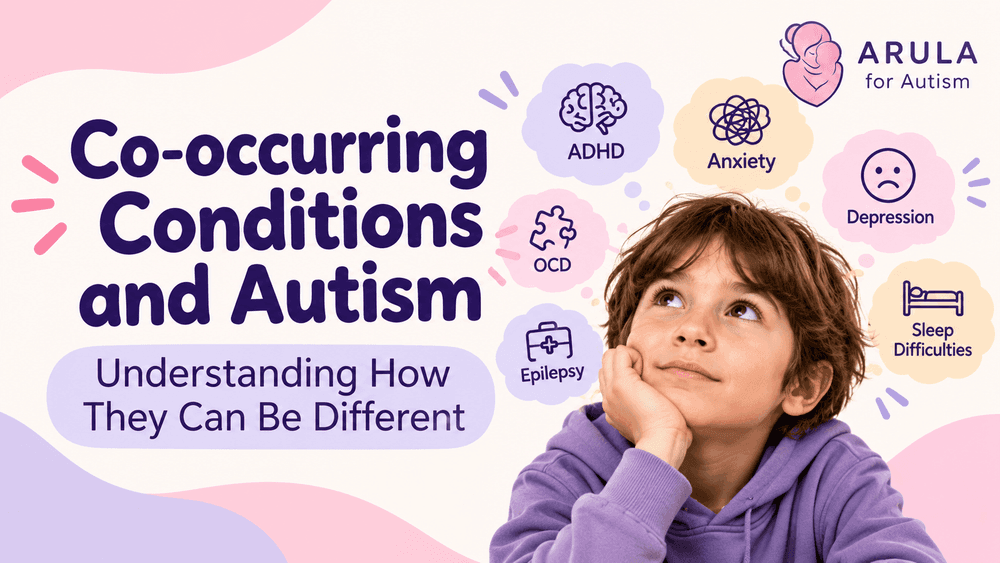
Co-occurring Conditions and Autism: Understanding How They Can Be Different
Autism does not always occur on its own. Explore common co-occurring conditions such as ADHD, anxiety, depression, and sleep difficulties, understand how they may overlap with autistic characteristics, and discover why recognising individual needs is essential for providing the right support.
AF
ARULA for Autism
· 3 min read
Introduction
Autism is a neurodevelopmental condition, but it does not always occur on its own. Many autistic individuals also experience other conditions that can influence their development, behaviour, communication, learning, and everyday lives. These are known as co-occurring conditions.
Understanding these conditions is important because they can sometimes overlap with, or be mistaken for, characteristics of autism. Recognising the differences helps families and professionals provide more appropriate and individualised support.
What Are Co-occurring Conditions?
Co-occurring conditions are additional medical, developmental, or mental health conditions that may be present alongside autism.
Some commonly reported examples include:
ADHD: Differences in attention, impulsivity, and activity levels.
Anxiety: Excessive worry, fear, avoidance, or difficulty managing uncertainty.
Depression: Persistent low mood, reduced interest, and changes in motivation.
OCD: Repetitive thoughts and compulsive behaviours that can cause distress.
Epilepsy: A neurological condition involving recurrent seizures.
Sleep difficulties: Problems with falling asleep, staying asleep, or maintaining regular sleep patterns.
Issues such as constipation, abdominal pain, and digestive discomfort.
Research highlights that co-occurring conditions are common among autistic children and adults, although their prevalence varies across studies and individuals (Lai et al., 2019; Hossain et al., 2023).
Why Can They Look Different in Autism?
One of the challenges is that some characteristics of co-occurring conditions may overlap with autistic characteristics.
For example:
Anxiety and autism: An autistic child may avoid social situations because of sensory discomfort, uncertainty, or difficulty navigating unfamiliar environments. However, anxiety may also contribute to avoidance. Understanding the underlying reason is important.
ADHD and autism: Both can influence attention, organisation, and daily routines. An individual with both conditions may experience additional challenges with concentration, impulsivity, and managing transitions.
Depression and autism: Changes in mood, energy, social participation, or interest in preferred activities may sometimes be overlooked or attributed to autism rather than recognised as possible signs of depression.
Sleep difficulties and autism: Sleep disturbances may affect emotional regulation, attention, learning, and behaviour, making everyday activities more challenging.
These examples highlight why it is important not to assume that every difficulty an autistic individual experiences is simply part of autism.
Why Is Early Identification Important?
Identifying co-occurring conditions allows families and professionals to understand an individual's needs more accurately.
Without appropriate assessment, additional difficulties may go unnoticed, potentially affecting emotional well-being, learning, participation, and quality of life.
Support should consider the whole individual rather than focusing exclusively on their autism diagnosis. This may involve collaboration between healthcare professionals, therapists, educators, and families.
Conclusion
Every autistic individual has a unique combination of strengths, experiences, and support needs. Co-occurring conditions can make this experience more complex, but recognising them helps us understand individuals beyond their autism diagnosis.
At ARULA for Autism, we believe that understanding the whole individual is essential. By recognising co-occurring conditions, looking beyond behaviour, and providing appropriate support, we can help autistic individuals achieve better well-being and reach their potential.
Because every individual deserves to be understood as more than a diagnosis.
References
Hossain, M. M., et al. (2023). Prevalence of co-occurring conditions in children and adults with autism spectrum disorder: A systematic review and meta-analysis. Neuroscience & Biobehavioral Reviews, 155, 105436. https://doi.org/10.1016/j.neubiorev.2023.105436
Lai, M. C., Kassee, C., Besney, R., Bonato, S., Hull, L., Mandy, W., Szatmari, P., & Ameis, S. H. (2019). Prevalence of co-occurring mental health diagnoses in the autism population: A systematic review and meta-analysis. The Lancet Psychiatry, 6(10), 819–829. https://doi.org/10.1016/S2215-0366(19)30289-5
National Institute for Health and Care Excellence (NICE). (2011, updated 2017). Autism spectrum disorder in under 19s: Recognition, referral and diagnosis (CG128). https://www.nice.org.uk/guidance/cg128