How Much Does Autism Therapy Cost in India? A Complete Breakdown
Discover practical insights, expert guidance, and compassionate strategies to help families better understand autism and support their child’s development.
AF
ARULA for Autism
· 6 min read
Understanding Autism Therapy Costs
Definition :- Autism therapy costs refer to the financial investment families make to support their child's developmental needs through services such as speech therapy, occupational therapy, behavioral intervention, special education, and developmental support programs.
For many families, understanding these costs can feel overwhelming. After receiving an Autism Spectrum Disorder (ASD) diagnosis, parents often find themselves navigating multiple recommendations, therapy schedules, and long-term planning decisions. While intervention can play an important role in supporting communication, participation, emotional regulation, and independence, the financial commitment can be significant.
Why Understanding Autism Therapy Cost is Important?
When families understand therapy costs, they are better able to make informed decisions that support both their child's development and family well-being.
The goal is not simply to increase the number of therapy sessions. Rather, it is to create opportunities for:
Sustainable intervention is often more effective than approaches that create excessive stress for the family system.
Why Are Therapy Costs So High?
Need for Multiple Professionals
Children with autism often require support across several developmental domains. This means families may work with speech therapists, occupational therapists, psychologists, behavioural specialists, and special educators simultaneously
Long-Term Nature of Intervention
Autism intervention is typically ongoing. Developmental skills such as communication, flexibility, self-regulation, and adaptive functioning often require consistent support over many years.
Limited Specialist Availability
In many regions of India, access to qualified autism professionals remains limited. Increased demand combined with limited availability can contribute to higher therapy costs.
Additional Family Expenses
Many families also manage additional expenses which can significantly add to the overall financial burden.
Travel costs
Assessment fees
Educational support expenses
Therapy materials and resources
Time away from work for appointments
Understanding Autism Therapy Costs in India
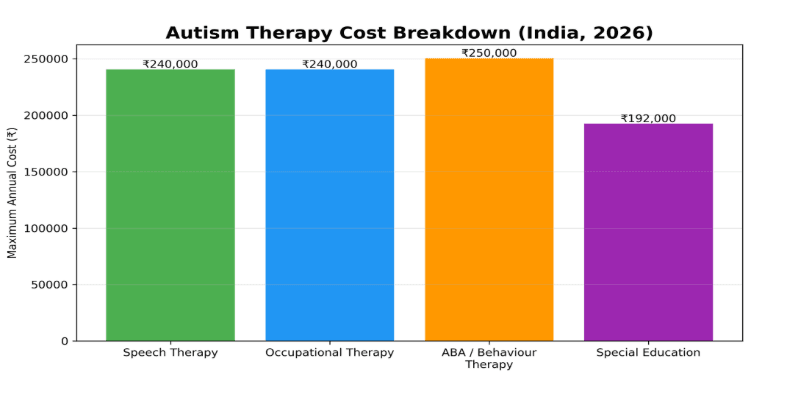
cost_breakdown
Autism intervention is different from many other healthcare services because it is often developmental rather than short-term. Progress typically occurs gradually through consistent support, repetition, and meaningful participation in daily life.
Many children may attend several therapy sessions each week, often involving a combination of:
Speech and language therapy
Occupational therapy
Behavioral intervention
Special education support
Parent consultation sessions
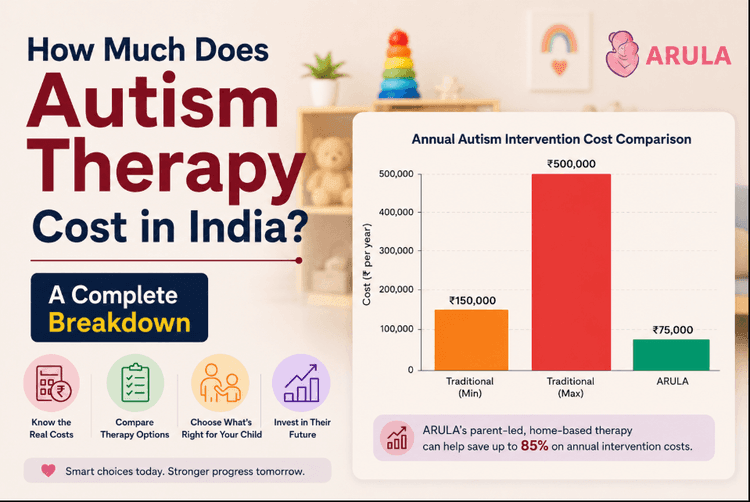
Depending on the child's needs, families may spend anywhere from ₹15,000 to ₹80,000 or more per month on therapy services. This means annual costs can range from approximately ₹1.8 lakh to over ₹9 lakh per year. For some families, additional expenses such as travel, assessments, educational support, and therapy materials further increase the overall cost.
How ARULA Reduces the Financial Burden
ARULA is designed to provide comprehensive developmental support through a structured annual subscription model.
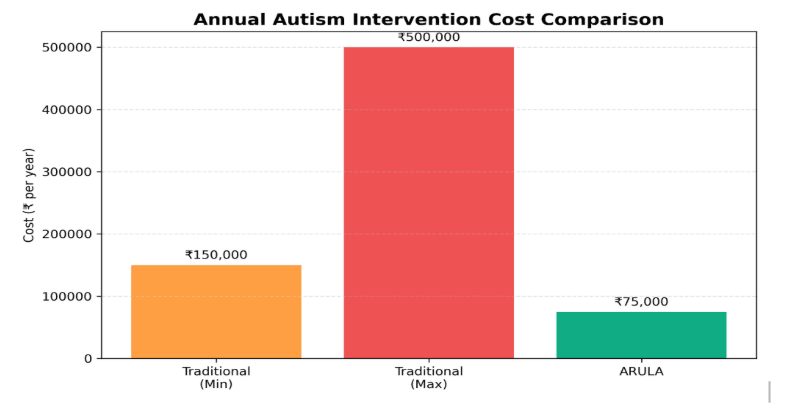
Annual Cost: ₹75,000
For approximately ₹75,000 per year, families receive ongoing guidance and support that extends beyond isolated therapy sessions. This predictable pricing model allows parents to budget more effectively while ensuring continuous access to professional expertise throughout the year.
cost_comparison
Benefits Included in the ARULA Annual Subscription
1. Continuous Access to Therapists
Unlike traditional models where support is limited to scheduled appointments, ARULA provides ongoing access to trained professionals who can guide parents through developmental challenges as they arise.
This ensures that families receive timely support without the need to book additional costly consultations.
2. Monthly Expert Review Meetings
ARULA includes regular monthly meetings with professionals to:
Review developmental progress
Discuss challenges and concerns
Adjust intervention strategies
Set developmental goals
Monitor family implementation
These consistent check-ins help ensure that intervention remains individualized and responsive to the child's changing needs.
3. Year-Long Structured Support
Many therapy programs focus primarily on individual sessions. ARULA emphasizes sustained developmental growth through a year-long framework that provides continuity and consistency.
Families receive guidance throughout the entire intervention journey rather than relying on fragmented services.
4. Parent Empowerment and Training
Research consistently demonstrates that parents play a critical role in supporting child development. ARULA equips caregivers with practical tools and strategies that can be incorporated into everyday routines.
This approach enables therapeutic learning opportunities to occur naturally throughout the day, maximizing developmental gains without increasing costs.
5. Reduced Need for Multiple Service Providers
Because ARULA takes a holistic approach, families may be able to reduce dependence on multiple separate interventions and consultations.
This integrated model can save both money and time while promoting consistency across developmental goals.
6. Greater Convenience for Families
Traditional therapy often requires frequent travel and scheduling adjustments. ARULA minimizes these challenges by providing structured support that is easier to integrate into family life.
Benefits include:
Reduced travel expenses
Less disruption to family schedules
Increased caregiver participation
Better consistency in intervention implementation
Conclusion
Understanding autism therapy costs involves more than calculating annual expenses. It also involves understanding how children learn, how development unfolds, and how families can create supportive environments that encourage growth. Access to quality autism support should not be limited by financial barriers.
That is why, ARULA offers an affordable and sustainable alternative to traditional therapy models through its annual subscription structure, therapist accessibility, monthly professional reviews, and year-long developmental support.
At approximately ₹75,000 annually, ARULA provides families with consistent expert guidance, caregiver empowerment, and a holistic framework for supporting their child's growth making effective intervention more accessible, practical, and cost-effective for families across India.
When families are supported, informed, and empowered, they are better equipped to help their children build confidence, independence, and lasting developmental skills. Progress may be gradual, but every step toward greater participation and connection is meaningful.
References
India Autism Center. (2026). A to Z Guide of Autism Therapies. The guide notes that private autism therapy sessions in major Indian cities commonly range between ₹500 and ₹3,000 per session, depending on the type of therapy and provider expertise. (IAC)
Patra, S., & Kar, S. K. (2021). Autism Spectrum Disorder in India: A Scoping Review. International Review of Psychiatry, 33(1–2), 81–112. This review highlights challenges in autism service delivery, intervention access, infrastructure limitations, and the need for evidence-based interventions in India. (PubMed)
Dutta, S., Rathore, B., & Vyas, G. (2025). Cost Benefit Analysis (CBA) of the Different Therapies for the Autistic Patients at a Tertiary Care Hospital in Bengaluru, India. European Economic Letters, 15(2), 3735–3738. The study reports the substantial economic burden experienced by families raising children with autism in India. (European Economic Letters)
How Much ABA Therapy Cost in India? (2026). HireForCare. This report estimates ABA therapy costs between ₹800 and ₹2,000 per session, with annual costs commonly ranging from ₹1 lakh to ₹2.5 lakh or more depending on therapy intensity. (HireForCare)
Kalorath, N., Menon, S. B., & Jayan, C. (2022). A Systematic Review on Parent-Mediated Intervention Programmes for Children with Autism Spectrum Disorders in India. International Journal of Community Medicine and Public Health. The review supports the effectiveness and feasibility of parent-mediated intervention approaches in the Indian context. (IJCMPH)
Dutta, A., et al. (2025). Autism Spectrum Disorder: An Indian Perspective. Medical Journal Armed Forces India, 81(5), 501–505. The review discusses disparities in access to autism services across India and emphasizes the importance of caregiver-mediated intervention models. (ScienceDirect)
Dababnah, S., Ghosh, S., Campion, K., et al. (2018). Autism Interventions in India: A Systematic Review. Review Journal of Autism and Developmental Disorders, 5(2). The review highlights the limited availability of culturally adapted autism interventions and services across India. (ResearchGate)
India Autism Therapy Market Size and Forecasts 2031. Mobility Foresights. This report identifies high therapy costs, therapist shortages, and limited rural access as major barriers to autism intervention in India. (Mobility Foresights)
ARULA for Autism·
ARULA's Brain Gymming Exercises: Turning Everyday Play into Opportunities for Brain Development
ARULA's Brain Gymming exercises can create meaningful learning opportunities for autistic children, supporting attention, working memory, inhibitory control, cognitive flexibility, motor coordination, and social communication. Through child-centred activities and parent-mediated approaches, familiar routines can encourage learning, communication, independence, and participation in daily life.
Every Child Deserves
The Opportunity To Thrive.
Every child has potential. Sometimes they simply need someone who believes in them deeply enough to help it emerge. Take the first step today.