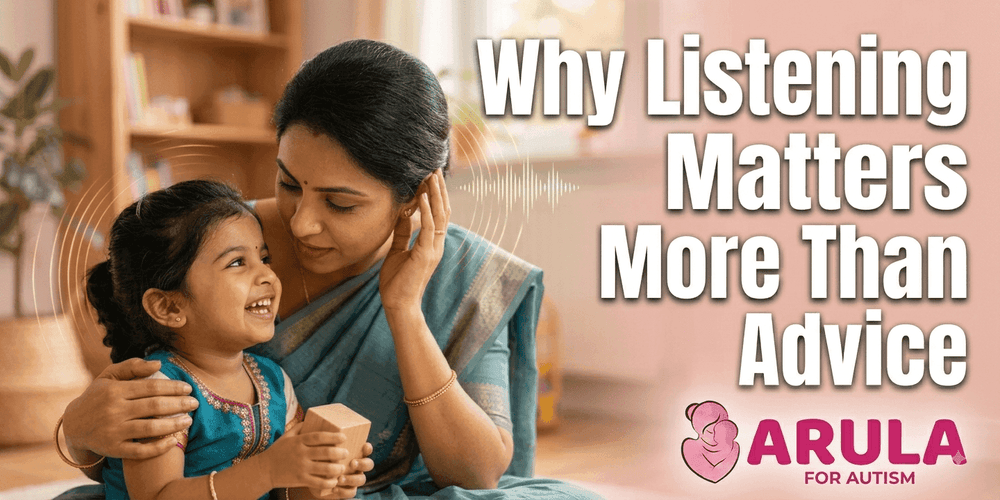
In the world of autism care, parents are often flooded with information—diagnostic terms, therapy plans, checklists, and milestones. Yet, what many truly crave is a space to be heard without judgment. At ARULA for Autism, we believe that empathetic listening is the foundation of effective therapy—not just for the child, but for the entire family.
AF
ARULA for Autism
· 4 min read
In the world of autism care, parents are often flooded with information—diagnostic terms, therapy plans, checklists, and milestones. Yet, what many truly crave is a space to be heard without judgment.
Listening does more than soothe emotions; it shapes neurological and behavioral outcomes. Research in developmental neuroscience shows that responsive listening—where one’s emotions are acknowledged and mirrored—activates oxytocin and dopamine pathways in the brain. These neurochemicals lower stress, stabilize heart rate, and foster emotional security.
For a parent navigating the uncertainty of autism, this emotional safety becomes the foundation for strength and consistency—the very elements a child depends on for stability and progress.
The Science Behind Empathetic Communication
Empathy is not abstract—it is biopsychosocial. When a caregiver or therapist listens with genuine attention:
Cortisol (stress hormone) levels decrease in both speaker and listener, reducing physiological tension (Davidson & McEwen, 2012).
The vagus nerve, a key player in emotional regulation, becomes activated through soothing vocal tones, leading to calmness and safety (Porges, 2011).
Mirror neurons, responsible for empathy and imitation, engage—supporting connection and learning.
In autism, where children may struggle to interpret social-emotional cues, the caregiver’s tone and attuned response become a bridge between worlds. And when parents themselves feel heard, they can transmit that calm, regulated energy back to their child (Feldman, 2017).
The Emotional Core of ARULA
At ARULA for Autism, empathy isn’t an add-on—it’s the foundation of our model.
We recognize that parents are not just “carriers” of therapy—they are co-regulators, emotional anchors, and first responders in their child’s development.
🌿 Mother-Centric, Child-Directed Approach
Every session begins with the parent’s emotional readiness. We build parental self-regulation first—because a calm parent creates a calm child. When parents feel validated, their tone, rhythm, and body language naturally become more attuned to their child’s sensory and emotional needs (Rogers, 1957).
🎧 Auditory-Led Regulation
ARULA emphasizes the therapeutic power of voice and listening. According to Polyvagal Theory, the human voice—especially a warm, familiar one—activates the social engagement system, helping children transition from “fight or flight” to “rest and connect” (Porges, 2011).
By using the caregiver’s voice and gentle touch as co-regulating tools, ARULA strengthens the bond between parent and child while reducing anxiety and behavioral stress.
💞 Community of Shared Experience
Empathy thrives in community. ARULA facilitates online parent circles, shared learning sessions, and real-time discussions. This social connection reduces caregiver burnout and reinforces therapy consistency (Wampold, 2015).
Listening as a Therapeutic Tool
Empathetic listening is not passive—it’s active co-regulation.
For children, being heard builds trust and reduces outbursts. It teaches that communication—verbal or nonverbal—will be met with understanding, not frustration. For parents, being heard helps process grief, confusion, and fatigue, turning emotional overload into clarity and confidence (Davidson & McEwen, 2012).
Research consistently shows that reflective, emotion-focused communication enhances therapeutic outcomes more effectively than purely instructional approaches (Wampold, 2015). It transforms therapy from a checklist into a shared human experience.
Why Empathy Creates Lasting Change
A child’s emotional regulation begins with co-regulation—the caregiver’s ability to remain calm and responsive under stress. When parents are supported through empathy, they:
Respond rather than react.
Reconnect emotionally after meltdowns.
Maintain consistency and structure during challenges.
These qualities are the bedrock of sustainable therapy outcomes. Empathy strengthens family systems, promotes resilience, and enhances neurodevelopment through secure attachment and emotional attunement (Feldman, 2017).
The ARULA Difference: Listening Beyond Words
ARULA’s mission extends beyond structured intervention—it’s about fostering a culture of care. Our team listens to both the spoken and unspoken: the parent’s silence, hesitation, or exhaustion.
When parents are emotionally supported, they are better equipped to handle sensory meltdowns, communication challenges, and day-to-day uncertainties. Listening becomes an act of healing—for both the giver and receiver.
Positive Reviews: Real Stories, Real Impact
ARULA’s commitment to empathy and connection is reflected in the voices of parents across India who’ve found strength, hope, and progress through our approach.
💬 “ARULA gave me my confidence back. I stopped blaming myself and started enjoying time with my child again.” — Parent, Delhi
💬 “We live in a small city with no access to therapy. ARULA made it possible to bring professional support into our home.” — Parent, Kochi
💬 “For the first time, I felt understood. The focus on my emotional well-being changed how I connected with my child.” — Parent, Nagpur
💬 “It’s not just therapy—it’s a community. I found friends who actually get it.” — Parent, Pune
These stories represent more than outcomes—they represent healing through empathy, community, and the simple power of listening.
How You Can Join the Community
You don’t have to be an expert to help—you just have to listen. Here’s how you can make a difference:
💬 Offer empathy, not judgment.
🌱 Ask parents how they’re feeling, not just how the child is.
🔄 Share awareness and resources.
💌 Encourage open, stigma-free conversations about autism.
Each empathetic act builds a ripple of connection that strengthens the entire autism community.
A Small Act, A Big Ripple
Listening is love in action. At ARULA for Autism, every voice matters. Every story is heard. Every small progress is celebrated.
We’re not just teaching therapy; we’re nurturing connection, one conversation at a time.
If this message resonates with you: 💙 Share this post to reach another family. 🔔 Join ARULA’s newsletter for parent insights, tools, and guidance. 🫶 Be the empathetic ear that changes someone’s autism journey today.