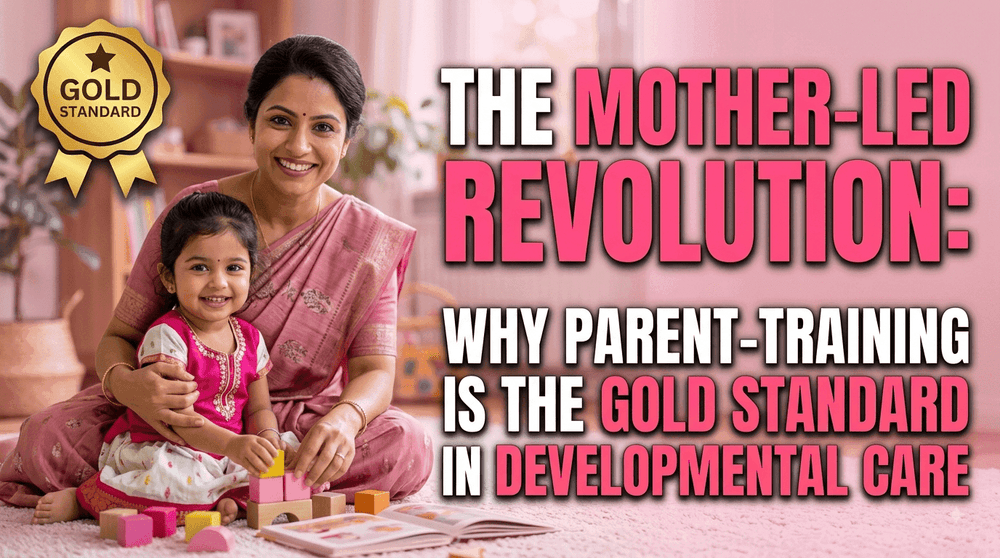
The Mother-Led Revolution: Why Parent-Training Is the Gold Standard in Developmental Care
Parent-training has emerged as a transformative approach in developmental care for children with autism. By empowering caregivers with evidence-based strategies, parent-training leverages the natural dynamics of daily life. This article explores the rationale behind parent-training, its implementation, and the robust evidence supporting it.
AF
ARULA for Autism
· 8 min read
Parent-training — sometimes called parent-mediated or parent-implemented intervention — is no longer a niche idea. Over the past two decades a growing body of rigorous research has shown that when caregivers are taught evidence-based strategies and coached to use them consistently in daily life, children with developmental differences (especially autism) make meaningful gains in communication, social engagement, and adaptive functioning. What began as pragmatic necessity in low-resource settings has become, in many circles, the gold standard for early developmental care.
This article explains why parent-training works, how it is implemented, what the evidence shows, and why mother-centric or caregiver-led programs are uniquely positioned to scale high-quality care across diverse settings.
Why parent-training? The logic and mechanisms
At its core, parent-training leverages three simple facts:
Parents are with their children far more than therapists are. This gives caregivers vastly more opportunities for repeated, naturalistic learning trials — the kind of dense, everyday practice that consolidates skill learning.
Learning is social and relational. The child’s most salient social partner is usually a caregiver. When parents use responsive interaction strategies (e.g., following the child’s lead, modeling language, pacing interaction, and creating scaffolded opportunities), they tap the child’s intrinsic motivation to engage and learn.
Caregiver behaviour shapes the child’s neurobiology. When caregivers respond contingently and calmly, the child’s stress physiology shifts (reduced cortisol, improved vagal tone), creating a better internal context for learning and social engagement (Feldman, 2017; Porges, 2011).
Put together, these mechanisms explain why parent-training is not merely a stopgap but a therapeutic modality: it changes the ecology of learning around a child, not just isolated session time.
What does parent-training involve? Typical components
Parent-training programs vary, but most high-quality models include:
Psychoeducation: Simple, evidence-based information about development and autism.
Skills coaching: Concrete strategies (e.g., following the child’s focus, modeling language, turn-taking, prompting and fading) taught through demonstration and role-play.
Video feedback and fidelity checks: Parents are recorded interacting with their child and receive coaching on specific moments to refine techniques. Video feedback improves caregiver skill acquisition and helps maintain fidelity.
Practice and generalization: Caregivers are coached to embed strategies into everyday routines — mealtime, play, bath time — so skills generalize across contexts.
Emotional support and problem solving: Effective programs include space for parental reflection, stress management, and troubleshooting barriers to practice (e.g., family schedules, culture, resources).
Examples of well-studied approaches include the Paediatric Autism Communication Trial (PACT) model, the Early Start Denver Model (ESDM) parent-implemented versions, and a variety of play-based parent coaching programs (Green et al., 2010; Vismara et al., 2018).
What does the evidence say? Meta-analyses and trials
The research base for parent-mediated interventions (PMIs) is now substantial and increasingly robust:
Systematic reviews and meta-analyses consistently report moderate positive effects for parent-implemented interventions on child social communication, language, and adaptive behaviour, and on parental outcomes such as self-efficacy and stress reduction (Conrad et al., 2021; Cheng et al., 2023). A large meta-analysis found overall moderate effect sizes across multiple outcomes for PIIs (Cheng et al., 2023).
Randomized controlled trials (RCTs) of structured parent-mediated programs, including landmark trials like the PACT study, report improvements in parent–child interaction quality and child social communicative behaviour; some trials have demonstrated downstream improvements in diagnostic ratings or functional engagement (Green et al., 2010; Rahman et al., 2016).
Reviews focused on the early years — when neural plasticity is highest — show that very early parent-mediated interventions can produce cascading benefits, especially when parents achieve high fidelity to the taught strategies (Jhuo et al., 2022; Vismara et al., 2018).
Critically, meta-analytic work also shows variability: interventions are more effective when they are of sufficient intensity, when parents receive ongoing coaching (not just a one-off workshop), and when cultural adaptation and feasibility are considered (Deb et al., 2020; Cheng et al., 2023).
Why mother-led (or caregiver-led) models are particularly powerful
Many parent-training initiatives emphasize mothers as primary participants. There are practical reasons — mothers often serve as the child’s main daily caregiver — but there are also therapeutic benefits:
Continuity: Mother-led strategies can be used many times every day across contexts, creating the practice density children need.
Emotional co-regulation: When a mother learns to modulate tone, pacing, and proximity, she directly improves the child’s physiological state (reduced stress, increased social engagement). Polyvagal mechanisms are relevant here: prosodic, soothing vocal patterns activate the social engagement system (Porges, 2011).
Parental mental health gains: Training which includes emotional support and community reduces parent stress and improves confidence; these changes in caregiver wellbeing mediate better child outcomes (Deb et al., 2020; Abid et al., 2024).
That said, inclusive models work: father-led, grandparent-led, and multi-caregiver training are equally valuable when implemented with fidelity and cultural sensitivity.
Implementation at scale: telehealth, low-intensity models and cultural adaptation
One reason parent-training is the gold standard is its scalability:
Telehealth parent coaching has been successfully piloted and trialed, showing that remote coaching can produce similar gains to in-person coaching when proper structure and supervision are present (Vismara et al., 2018; Conrad et al., 2021). Telehealth dramatically increases reach to rural and underserved communities.
Low-intensity, task-shifting models (brief training + periodic supervision) have promising results for expanding access in low- and middle-income contexts and can be cost-effective when bundled with community health systems (Patel et al., 2011).
Cultural adaptation matters. Programs that carefully adapt language, examples, and parental roles to local contexts improve acceptability and uptake (Lopez et al., 2024).
Common barriers — and how programs overcome them
Despite strong evidence, implementing parent-training at scale faces challenges:
Time and burden: Busy parents may struggle to practice daily. Successful programs emphasize embedding strategies into existing routines (mealtimes, play) rather than adding extra “homework.”
Fidelity drift: Without ongoing feedback, parents may stop using strategies correctly. Video-feedback and periodic coaching reduce drift.
Stigma and skepticism: Clear psychoeducation and community support networks reduce stigma and improve engagement.
Resource gaps: Telehealth, group coaching, and brief clinician supervision help bridge specialist shortages in Tier-2/3 settings.
When these barriers are addressed, outcomes improve and families report better confidence and reduced stress (Abid et al., 2024; Conrad et al., 2021).
ARULA for Autism — leading the mother-led revolution
A growing number of evidence-based programs have inspired community adaptations; among these models, ARULA for Autism represents a culturally attuned, mother-centric approach that aligns closely with the research principles described above.
What ARULA emphasizes and how it connects with the evidence base
Mother-centric, child-directed coaching. ARULA positions caregivers—often mothers—as the primary agents of intervention, training them to embed strategies into daily routines (mealtimes, play, bedtime). This mirrors the practice-density logic that underpins effective PMIs (Vismara et al., 2018; Green et al., 2010).
Auditory-led learning with minimal visual dependence. ARULA prioritizes caregiver voice, prosody, and touch to foster co-regulation and social engagement. This emphasis on vocal co-regulation is consistent with findings from Polyvagal Theory and research showing that caregiver vocal tone and attuned interaction support physiological regulation important for learning (Porges, 2011; Feldman, 2017).
Telehealth and digital coaching to expand reach. ARULA’s online modules and remote coaching formats reflect the effective telehealth strategies observed in trials of parent coaching, improving access for families in Tier-2 and Tier-3 cities where in-person specialist care is scarce (Vismara et al., 2018; Waddington et al., 2024).
Emotional support & parent community. ARULA embeds peer groups and reflective sessions into its curriculum, addressing caregiver wellbeing — a known mediator of child outcomes (Deb et al., 2020; Wampold, 2015).
Impact and positioning
While randomized controlled data specific to ARULA may be forthcoming, the program’s model intentionally follows those elements shown in the research to produce meaningful change: coached parent practice, daily routine embedding, fidelity checks, and caregiver wellbeing support (Conrad et al., 2021; Cheng et al., 2023). Early user feedback and success stories indicate improved parent confidence, greater consistency of home-based practice, and increased accessibility to interventions for families outside major urban centres (see program testimonials and case summaries).
In other words, ARULA operationalizes the scientific consensus about parent-mediated care and adapts it for scalable, culturally relevant delivery—helping to drive the broader “mother-led revolution” toward mainstream developmental care.
Practical takeaways for clinicians, program designers and parents
Train caregivers early and actively. Teach practical interaction strategies, demonstrate them, and provide coached practice with feedback.
Embed learning in routines. Focus on natural contexts (meals, play, bath time) to maximize practice density.
Use video and telehealth to maintain fidelity. Remote coaching plus video review is cost-effective and scalable.
Support parental wellbeing. Emotional support and peer groups are part of effective models.
Culturally adapt materials. Local language examples and culturally relevant routines increase uptake.
Conclusion: why parent-training is the gold standard
Parent-training is not a low-cost substitute for professional therapy — it is therapy. It leverages the most powerful agent of change in a child’s life: emotionally attuned, repeated interactions with a caregiver. Robust evidence from meta-analyses and RCTs supports what clinicians and families have long observed: when caregivers are trained, coached, and supported, children’s developmental trajectories improve in measurable ways (Conrad et al., 2021; Cheng et al., 2023).
Scaling caregiver-led models through telehealth, culturally informed curricula, and attention to caregiver wellbeing provides a realistic path to equitable, effective developmental care worldwide. Programs such as ARULA for Autism illustrate how these principles can be adapted and implemented at scale—particularly in settings where access to specialists is limited. The mother-led revolution is not about replacing professionals; it is about amplifying their work by equipping families to be the everyday, consistent engine of learning.