The Mental Health of Autism Parents in India: Why No One Talks About It
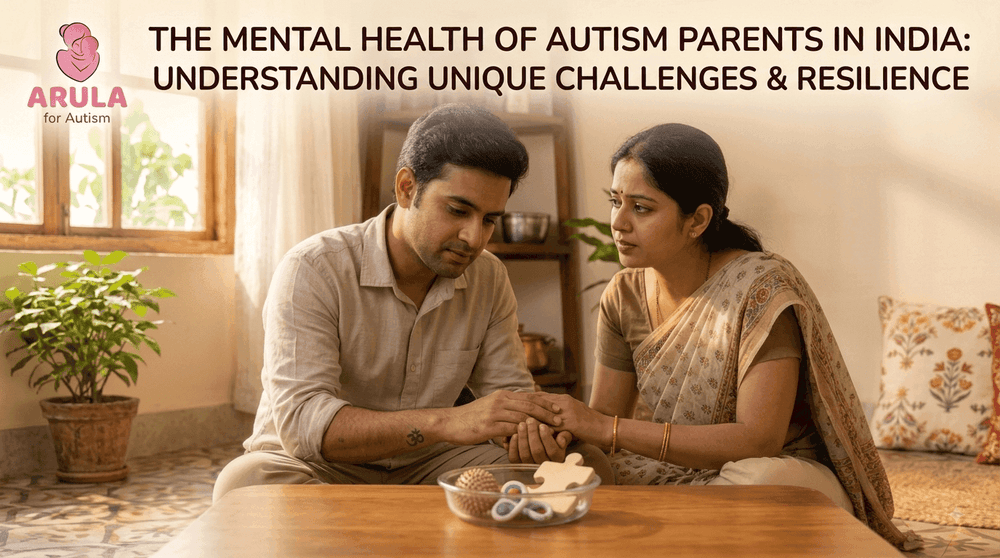
Parenting a child with autism can be challenging, and the mental health of parents is often overlooked. This article explores the unique stressors faced by autism parents in India and the importance of addressing their psychological well-being.
AF
ARULA for Autism
· 7 min read
Definition
The mental health of autism parents refers to the emotional, psychological, and physical well-being of parents and caregivers who support an autistic child in everyday life.
This includes experiences such as:
stress
anxiety
emotional exhaustion
caregiver burnout
guilt
grief
loneliness
worry about the future
While conversations about autism often focus on the child's development, therapy goals, education, and support needs, the emotional experiences of parents frequently remain unspoken.
Within developmental approaches such as ARULA, the well-being of caregivers is viewed as an important part of the child's developmental environment. Children do not grow in isolation. They develop within relationships, routines, and family systems. Supporting the child therefore also involves understanding and supporting the people who care for them every day.
Understanding the Emotional Journey of Autism Parenting
Receiving an autism diagnosis—or even beginning the journey toward assessment—can be a life-changing experience for many families.
Parents often find themselves navigating a world filled with new terminology, appointments, therapies, school meetings, and decisions about their child's future. Alongside these practical responsibilities comes a complex emotional journey that is rarely discussed openly.
Many parents describe experiencing multiple emotions at the same time.
There may be relief at finally understanding their child's differences. There may also be confusion, fear, uncertainty, sadness, hope, determination, and overwhelm.
These emotions are not contradictory.
They are often part of adapting to a new reality and learning how to support a child whose developmental path may look different from what was originally expected.
Research consistently shows that parents of autistic children report higher levels of stress and emotional burden compared to parents of typically developing children. However, this does not mean that parenting an autistic child is inherently negative. Rather, it reflects the additional demands, uncertainties, and systemic challenges that many families face.
Why This Conversation Often Remains Silent in India
Mental health remains a difficult topic in many communities.
For autism parents, discussing emotional struggles can feel even more complicated.
Many parents worry that acknowledging their stress may be interpreted as a lack of love for their child. Others fear judgment from relatives, friends, or society.
Some parents hear statements such as:
"Be strong."
"Other people have it worse."
"Everything will be fine."
"Don't think negatively."
Although often well-intentioned, these responses can unintentionally make parents feel that their emotions should be hidden rather than expressed.
In many Indian families, caregiving responsibilities are viewed as a duty that should simply be accepted and managed. Parents may feel pressure to remain strong at all times, even when they are struggling internally.
As a result, many continue carrying significant emotional burdens without support.
What ARULA Observes About Caregiver Well-Being
ARULA views caregiver well-being as an important part of a child's developmental environment.
Rather than asking only:
"How is the child doing?"
The framework also considers:
How is the family coping?
How much support do caregivers have?
Are parents experiencing chronic stress?
Is the home environment emotionally sustainable?
What factors are contributing to family overwhelm?
Children are highly sensitive to the emotional climate around them.
This does not mean parents must remain happy or calm all the time.
Rather, it recognizes that supporting caregiver well-being ultimately supports family functioning and participation for everyone involved.
The Invisible Responsibilities Parents Carry
Many autism parents describe feeling as though they are constantly "on duty."
A typical day may involve:
managing therapy schedules
supporting communication needs
helping with daily living skills
coordinating school requirements
advocating for accommodations
handling sensory challenges
responding to emotional regulation difficulties
Alongside these responsibilities, parents are often also managing:
careers
household responsibilities
finances
relationships
extended family expectations
From the outside, others may only see a parent taking their child to therapy.
What they often do not see is the planning, emotional labor, research, decision-making, and advocacy happening behind the scenes.
Over time, this constant responsibility can become exhausting.
The Weight of Worrying About the Future
One of the most common concerns among autism parents involves uncertainty about the future.
Parents often find themselves asking:
Will my child become independent?
What will school look like?
Will they have meaningful relationships?
Who will support them when I am no longer here?
Am I doing enough?
These questions arise because parents care deeply about their child's well-being.
However, constantly carrying future-focused worries can create significant emotional strain.
Many parents spend years living between the present moment and future uncertainties.
Learning to focus on current progress while acknowledging future concerns is often a gradual process.
When Guilt Becomes Part of the Journey
Guilt is another emotion many autism parents experience.
Parents may wonder:
Did I miss early signs?
Am I doing enough?
Should I be providing more therapies?
Am I spending enough time with my child?
Why am I feeling tired or frustrated?
Even highly dedicated parents often question themselves.
This self-doubt can become particularly intense when parents compare themselves to others or feel pressure to meet unrealistic expectations.
In reality, no parent can do everything perfectly.
Children benefit most from caregivers who are supported, emotionally available, and sustainable—not from caregivers who are constantly pushing themselves beyond their limits.
The Loneliness Many Parents Experience
Autism parenting can sometimes feel isolating.
Friends and relatives may not fully understand the family's daily experiences.
Social outings may become difficult due to sensory sensitivities, transitions, feeding challenges, or emotional regulation needs.
Over time, some families find themselves participating less in social events.
This isolation can create feelings of loneliness, even when parents are surrounded by people.
Many parents report that one of the most helpful experiences is simply connecting with other families who understand what life with autism actually looks like.
Feeling understood can significantly reduce emotional burden.
Why Supporting Parents Is Important
When discussing autism, support is often viewed exclusively through the child's needs.
However, families function as interconnected systems.
When caregivers experience chronic stress, exhaustion, or burnout, it can affect:
family routines
emotional regulation
participation in daily activities
relationships within the home
Supporting parents is therefore not separate from supporting the child.
It is part of creating a stable and sustainable environment for development.
Children often benefit when caregivers:
feel less overwhelmed
have access to support
receive opportunities for rest
experience emotional validation
How ARULA Methods Support Families
ARULA recognizes that developmental support extends beyond the child alone.
The approach encourages families to move away from constant pressure and toward greater understanding of:
regulation
participation
emotional safety
realistic expectations
Rather than focusing solely on performance or outcomes, ARULA encourages parents to understand the child's underlying experiences and developmental needs.
This shift often reduces stress because parents are no longer trying to "fix" every behavior.
Instead, they begin to understand what the child may be communicating through their actions.
The framework also emphasizes that progress is often gradual.
Children develop over time.
Parents grow alongside them.
Both deserve patience and compassion throughout the journey.
Caring for Yourself Is Not Taking Away From Your Child
Many parents feel guilty when they think about their own needs.
However, caring for yourself does not mean caring less for your child.
Emotional well-being allows parents to:
respond more calmly during difficult moments
manage stress more effectively
maintain long-term resilience
remain emotionally available
Sometimes self-care is not about elaborate activities.
It may simply involve:
asking for help
taking a short break
speaking with a trusted friend
joining a support group
seeking professional support when needed
Small moments of support can make a meaningful difference.
What Progress Looks Like for Parents
Just as children develop gradually, parents often develop new strengths over time.
Progress may look like:
feeling less overwhelmed by uncertainty
responding with greater confidence
accepting that perfection is impossible
building supportive relationships
recognizing personal limits without guilt
These changes are often subtle but deeply important.
Parenting an autistic child is not about having all the answers.
It is about continuing to learn, adapt, and grow alongside your child.
Conclusion
The mental health of autism parents is an important but often overlooked part of the autism journey.
Behind every therapy session, school meeting, developmental milestone, and daily routine is a caregiver who is carrying responsibilities, hopes, worries, and emotions that are rarely visible to others.
Within the ARULA framework, supporting the child also means acknowledging the well-being of the family. Children thrive in environments that are emotionally safe, sustainable, and supportive—not only for them, but for the people who care for them.
Parents do not need to be perfect.
They do not need to have endless energy or constant certainty.
They simply need support, understanding, and the space to be human while navigating a journey that can be both deeply rewarding and undeniably challenging.
Most importantly, caring for your own mental health is not separate from caring for your child.
It is an essential part of the process.
ARULA for Autism·
ARULA's Brain Gymming Exercises: Turning Everyday Play into Opportunities for Brain Development
ARULA's Brain Gymming exercises can create meaningful learning opportunities for autistic children, supporting attention, working memory, inhibitory control, cognitive flexibility, motor coordination, and social communication. Through child-centred activities and parent-mediated approaches, familiar routines can encourage learning, communication, independence, and participation in daily life.
Every Child Deserves
The Opportunity To Thrive.
Every child has potential. Sometimes they simply need someone who believes in them deeply enough to help it emerge. Take the first step today.