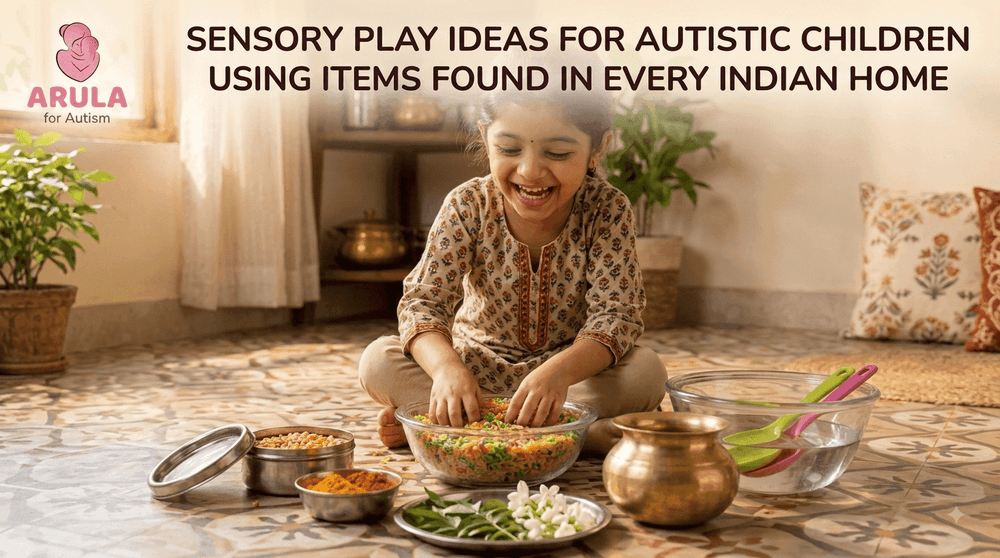
Sensory Play Ideas for Autistic Children Using Items Found in Every Indian Home
Sensory play is a powerful tool for supporting autistic children’s regulation, exploration, attention, communication, and participation in everyday life. It does not require expensive toys or specialized equipment. Many effective sensory experiences can be created using simple materials already found in Indian homes.
AF
ARULA for Autism
· 7 min read
Understanding Sensory Regulation Through Everyday Play
Sensory play refers to activities that engage a child’s senses, including:
touch
movement
sound
sight
smell
body awareness
For autistic children, sensory play is not simply entertainment or “time pass.” It often supports regulation, exploration, attention, communication, emotional comfort, and participation in everyday life.
Within developmental approaches such as ARULA, sensory play is understood as a way of helping children interact with the world more comfortably and meaningfully through safe, engaging experiences.
Importantly, sensory play does not require expensive toys or highly specialized equipment. Some of the most effective sensory experiences can be created using simple materials already found in Indian homes.
Understanding Sensory Needs in Autism
Many autistic children experience the world differently through their senses.
These sensory behaviors are often the child’s way of regulating their nervous system.
For many parents, sensory-seeking or sensory-avoidant behaviors can initially feel confusing. A child may avoid one texture strongly but constantly seek another. They may cover their ears in one situation but enjoy loud repetitive sounds in another.
This happens because sensory regulation is complex and deeply individual.
Sensory play gives children opportunities to explore sensory experiences in a safe, predictable, and emotionally supportive way.
Rather than trying to stop sensory behaviors completely, developmental approaches often focus on understanding what the child may be seeking or avoiding.
Why Sensory Play Is Important
Sensory experiences affect many areas of development, including:
emotional regulation
attention
participation
motor coordination
body awareness
communication
adaptive functioning
When children feel more regulated, they are often better able to:
engage socially
tolerate routines
participate in learning
communicate comfortably
transition between activities
Sensory play can also help children feel calmer, more organized, and emotionally secure.
Importantly, sensory play should not feel like “therapy” all the time. Play works best when children feel safe, curious, and emotionally connected during the activity.
What ARULA Observes During Sensory Play
ARULA looks beyond whether a child simply “plays correctly.”
Instead, the focus is on:
how the child responds to sensory input
what sensory experiences the child seeks or avoids
how regulation changes during play
whether the child becomes calmer, more engaged, or overwhelmed
Some children may:
avoid messy textures
crave movement
repeatedly pour or transfer objects
seek deep pressure
enjoy repetitive tactile experiences
These responses provide important information about the child’s sensory profile and regulation needs.
Sensory Play Using Everyday Indian Household Items
One of the most reassuring things for families is that sensory play does not need to be expensive or complicated.
Many meaningful sensory activities can be created using familiar materials already available at home.
The goal is not perfection or structured teaching. The goal is helping the child explore sensory experiences safely and comfortably.
Rice and Dal Play for Tactile Exploration
Dry rice, moong dal, chana, rajma, or other grains commonly found in Indian kitchens can provide rich tactile sensory experiences.
Children may enjoy:
scooping
pouring
transferring between containers
burying small objects
running hands through textures
These activities support:
tactile exploration
hand coordination
attention
calming repetitive movement
Some children may initially hesitate to touch certain textures. In these situations, gradual exposure without pressure is important.
The child may first observe, then touch briefly, and eventually participate more comfortably over time.
Atta Dough and Kitchen-Based Sensory Play
Simple atta dough can become an excellent sensory activity.
Children may enjoy:
squeezing
rolling
pressing
pulling
shaping
This type of play supports:
fine motor development
hand strength
tactile regulation
creativity
The familiar smell and texture of homemade dough can also feel emotionally comforting because it connects to everyday family routines.
Some families may add:
jeera
haldi
food colors
safe kitchen scents
to gently expand sensory experiences.
Water Play Using Buckets, Mugs, and Steel Utensils
Water play is highly regulating for many autistic children.
Using common household items such as:
buckets
mugs
steel bowls
spoons
strainers
children can explore:
pouring
splashing
floating
transferring water
Water play often supports:
calming
sensory regulation
sustained attention
body awareness
For many children, repetitive pouring activities feel predictable and soothing.
Even simple bathroom or balcony water play can become a meaningful sensory experience.
Sensory Play With Fabrics and Household Textures
Indian homes often contain many sensory-rich fabrics and textures.
Children can explore:
cotton dupattas
silk scarves
towels
wool
cushions
mats
This helps children experience:
soft textures
rough textures
temperature differences
movement and body awareness
Some children enjoy wrapping themselves in blankets or being covered with cushions because deep pressure can feel calming and organizing for the nervous system.
Spice and Smell Exploration
Smell-based sensory activities can be created gently using common Indian kitchen ingredients.
Children may explore mild scents such as:
elaichi
cinnamon
coffee
lemon
mint leaves
The goal is not forcing children to tolerate smells they dislike.
Instead, sensory exploration should remain low-pressure and curiosity-based.
Some children may enjoy smelling ingredients, helping in cooking routines, or sorting herbs and spices visually.
Movement-Based Sensory Play at Home
Not all sensory play involves touch.
Many autistic children seek movement because movement helps regulate the nervous system.
Indoor movement activities may include:
jumping on mattresses
carrying pillows
pushing laundry baskets
animal walks
rolling on beds
dancing to music
These activities support:
body awareness
coordination
emotional regulation
sensory organization
Children who constantly move are often not “misbehaving.” Their bodies may simply be seeking regulation through movement.
Sound and Rhythm Activities Using Household Objects
Indian homes naturally contain many opportunities for sound exploration.
Children may enjoy:
tapping steel utensils
shaking containers filled with grains
clapping rhythms
listening to repetitive sounds
musical imitation games
Some children find rhythm highly regulating because repetition feels predictable and organizing.
However, children who are sensitive to sound may need softer and quieter sensory experiences instead.
Sensory needs vary greatly from child to child.
Supporting Sensory Play at Home
Sensory play works best when it feels emotionally safe and flexible.
Parents do not need to constantly direct or “teach” during play.
In many cases, simply observing and joining the child gently is enough.
Children often benefit most when:
the environment feels calm
there is no pressure to perform
sensory exploration happens gradually
adults remain emotionally regulated
the child is allowed to explore in their own way
Not every activity will suit every child.
Some children may immediately enjoy messy play, while others may strongly avoid it. Both responses are valid.
Sensory preferences are deeply individual.
What to Avoid
Sensory play should not become overwhelming or forced.
It is important to avoid:
forcing uncomfortable textures
overwhelming the child with too many sensory inputs at once
treating sensory play as performance-based
correcting repetitive play constantly
expecting immediate tolerance for disliked sensations
When children feel emotionally safe, sensory flexibility often develops more naturally over time.
How ARULA Methods View Sensory Play
Within ARULA, sensory play is understood as part of regulation, participation, and developmental readiness.
The focus is not on making children appear “less autistic.” Instead, the goal is helping children:
feel more comfortable in their bodies
regulate sensory experiences
participate more meaningfully in daily life
build emotional safety and flexibility gradually
The ARULA method, developed by speech therapist Mayuri Ramdasi, emphasizes understanding the child’s sensory profile rather than forcing normalization.
Parents are encouraged to observe:
what calms the child
what overwhelms them
what sensory experiences support participation
Through everyday routines and low-pressure sensory opportunities, children are gradually supported toward greater regulation and engagement.
Conclusion
Sensory play does not need to involve expensive toys, complicated setups, or highly structured activities.
Some of the most meaningful sensory experiences can happen through everyday household routines using familiar materials already present in Indian homes.
For autistic children, sensory play is often much more than play alone. It can support regulation, comfort, communication, attention, and participation in daily life.
Most importantly, sensory play works best when children feel safe, accepted, and free to explore at their own pace.
Over time, these small and familiar sensory experiences can help children build greater confidence, regulation, flexibility, and connection within everyday family life.
ARULA for Autism·
ARULA's Brain Gymming Exercises: Turning Everyday Play into Opportunities for Brain Development
ARULA's Brain Gymming exercises can create meaningful learning opportunities for autistic children, supporting attention, working memory, inhibitory control, cognitive flexibility, motor coordination, and social communication. Through child-centred activities and parent-mediated approaches, familiar routines can encourage learning, communication, independence, and participation in daily life.
Every Child Deserves
The Opportunity To Thrive.
Every child has potential. Sometimes they simply need someone who believes in them deeply enough to help it emerge. Take the first step today.