Blog
From Frustration to Progress: Real Stories of Parents Using the ARULA Method
This blog explores three key ideas that have helped shape so many family journeys at ARULA: understanding how a child seeks sound, dealing with a mother’s exhaustion, and the healing power of bonding.
ARULA for Autism
· 5 min read
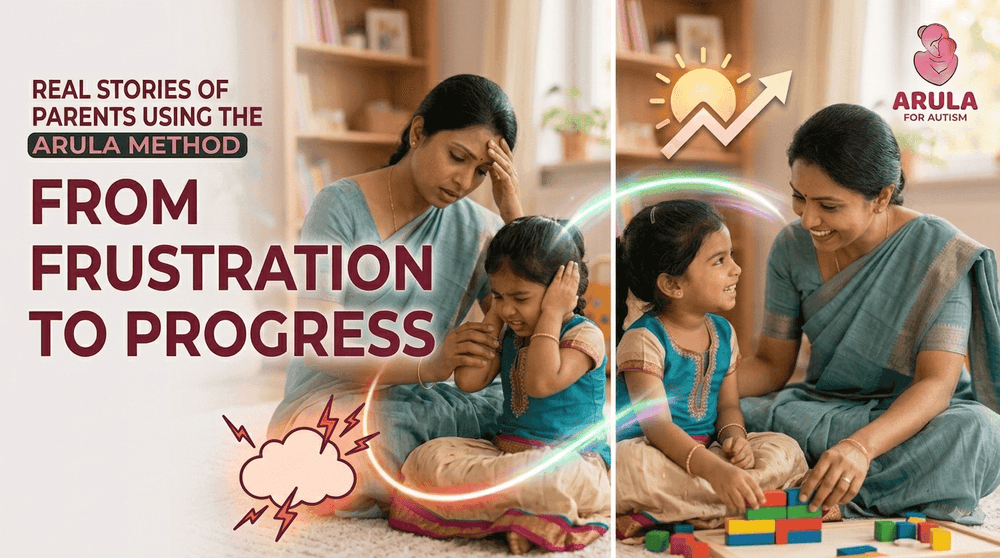
Being a parent is never a straight line, but when your child is neurodivergent, the path can feel extra complicated. You start with so many questions and worries, and you often feel exhausted. At ARULA, we meet parents who carry a silent burden—the sleepless nights, the constant worry, and the deep wish to see their child truly thrive. We've seen that what makes this journey remarkable isn't just a child’s progress, but a parent’s own transformation, from feeling hopeless to having new energy and hope.
This blog explores three key ideas that have helped shape so many family journeys at ARULA: understanding how a child seeks sound, dealing with a mother’s exhaustion, and the healing power of bonding.
The Secret Language of Sound
For many kids with autism, sound isn't just background noise—it's how they make sense of the world. They might tap objects over and over, hum, or even look for loud noises. To someone who doesn't understand, these behaviors can seem strange or disruptive. But at ARULA, we see them as auditory-seeking behaviors—a way for a child’s brain to find calm and focus.
Let's look at a child named Mayuri Yazh, who came to ARULA when she was just two and a half years old. At the time, she barely spoke, had trouble paying attention, and often did the same sensory-seeking actions over and over. Her mom, Dr. Vasuki, felt helpless watching her daughter play by herself for long periods, disconnected from everything around her.
Instead of trying to stop Mayuri's search for sound, ARULA helped channel it. We used games that involved sharing attention, rhythm-based activities, and guided sound exposure led by her mother. Mayuri’s tapping and humming slowly changed into vocal sounds, then attempts at words, and finally, full sentences she said on her own. In just eight months, her verbal skills jumped from a 1 to a 9 on a developmental scale.
Mayuri’s story teaches us a big lesson: Seeking sound isn't a problem; it's a starting point. When guided with patience and structure, it can become a path to speech, learning, and genuine connection.