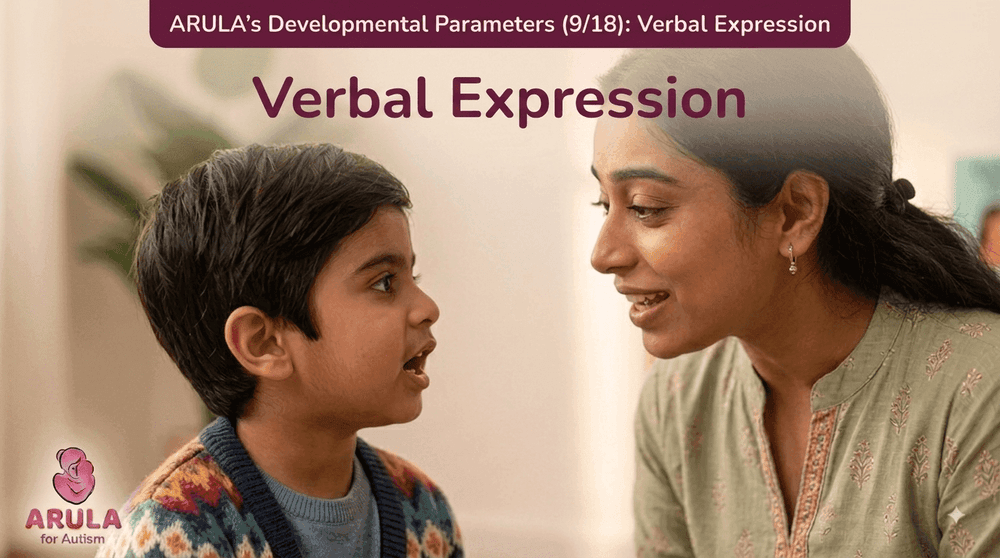
Verbal expression is a key developmental parameter that ARULA closely monitors. It refers to a child’s ability to use their voice to communicate meaningfully with others. This parameter encompasses not just the production of sounds, but the emotional intent and social connection behind those sounds. Verbal expression is a critical step in the communication journey, as it lays the groundwork for later speech development and social engagement.
AF
ARULA for Autism
· 5 min read
Understanding Speech Levels, Brain Foundations, and Functional Communication
Verbal expression refers to the level and quality of spoken language a child uses to communicate. While speech is often treated as the ultimate developmental milestone, it is more accurately understood as the visible outcome of multiple underlying systems working together. Emotional regulation, social motivation, auditory processing, motor planning, cognition, and environmental interaction all contribute to whether and how speech emerges.
In ARULA’s framework, verbal expression is assessed not simply by the presence of words, but by how speech functions in daily life—its flexibility, clarity, spontaneity, and communicative intent.
Categories of Verbal Expression
Speech development is highly variable. Children may move between categories over time, and these categories describe current functioning—not long-term potential.
Non-Verbal
Non-verbal children do not use spoken words consistently for communication. However, many non-verbal children:
demonstrate strong receptive language (understanding)
communicate through gestures, sounds, or behavior
use augmentative and alternative communication (AAC)
Research emphasizes that absence of speech does not equal absence of comprehension or intelligence (Tager-Flusberg & Kasari, 2013). Speech production may be limited by motor planning challenges, social communication differences, or neurological organization rather than cognitive delay.
Partially verbal children use spoken words but may:
rely on single words or short phrases
use language inconsistently
struggle with grammar and sentence expansion
depend on memorized scripts or repetition
At this stage, expressive systems are emerging, but integration across brain regions remains immature. Communication may still require significant support.
Fully Verbal
Fully verbal children use multi-word sentences and express a range of ideas. However, quality matters as much as quantity. Some fully verbal children may:
struggle with conversational turn-taking
have rigid or repetitive speech patterns
interpret language literally
find abstract reasoning challenging
Thus, verbal fluency does not always equate to social communication competence (Tager-Flusberg et al., 2005).
What ARULA Observes in Verbal Expression
ARULA evaluates speech across multiple dimensions:
Word Count
Provides a rough developmental marker, but does not measure flexibility, spontaneity, or functional communication.
Sentence Formation
Reflects grammatical development and working memory. ARULA observes pronoun use, verb tense, sentence complexity, and the ability to combine ideas meaningfully.
Functional Speech vs. Scripting
Functional speech is spontaneous and context-appropriate. Scripting (echolalia) involves repeating learned phrases. Research shows echolalia can serve communicative or regulatory purposes rather than being meaningless repetition (Sterponi & Shankey, 2014).
Clarity and Articulation
Speech clarity depends on motor coordination, breath control, and oral-motor precision. Motor speech disorders may affect articulation independently of language understanding (Shriberg et al., 2011).
Neurodevelopmental Foundations of Verbal Speech
Verbal speech is one of the most complex human behaviors. It requires the coordination of multiple brain systems working in synchrony. Understanding this helps parents see that speech delays often reflect developmental timing rather than lack of effort.
1. Language Comprehension Systems (Wernicke’s Area and Temporal Regions)
Located primarily in the left temporal lobe, Wernicke’s area and surrounding auditory regions help the brain interpret spoken language. These systems:
process word meaning
decode grammar
interpret tone and prosody
integrate auditory input with stored knowledge
Expressive language cannot develop fully without sufficient receptive understanding. In many children, receptive language develops ahead of expressive speech.
2. Speech Production Systems (Broca’s Area and Frontal Regions)
Broca’s area, located in the left frontal lobe, is responsible for:
planning speech sequences
organizing grammar
coordinating speech output
This region works closely with the motor cortex to translate linguistic ideas into precise mouth and tongue movements.
If this network develops more slowly or atypically, children may understand language well but struggle to produce it fluently.
3. Motor Planning and Oral-Motor Coordination
Speech requires fine motor control involving:
lips
tongue
jaw
breath regulation
Motor planning difficulties, such as those seen in childhood apraxia of speech, disrupt the brain’s ability to send clear movement instructions (Shriberg et al., 2011). This can result in inconsistent articulation despite strong comprehension.
4. Auditory Feedback and Self-Monitoring
When children speak, they listen to themselves. The auditory cortex provides feedback that helps refine pronunciation and rhythm.
If auditory processing differences exist, children may:
struggle with sound discrimination
mispronounce consistently
show unusual prosody
Feedback loops are essential for speech refinement over time.
5. Social Motivation and Reward Networks
Speech develops most robustly in socially rewarding contexts. Neural reward pathways reinforce communication when it results in connection, attention, or shared experience.
Research on social feedback loops demonstrates that children increase vocal output when caregivers respond contingently (Warlaumont et al., 2014). Reduced social reinforcement can slow expressive development.
6. Executive Function and Working Memory
Producing sentences requires holding multiple words in mind simultaneously. The prefrontal cortex supports:
organizing ideas
inhibiting irrelevant thoughts
sequencing language
Immature executive function can limit sentence complexity even when vocabulary is strong.
7. Emotional Regulation Systems
Emotional states strongly affect speech output. Anxiety, sensory overload, or dysregulation can temporarily reduce verbal capacity. In calm states, speech often increases.
Speech is therefore not purely linguistic—it is emotional and physiological.
Why Speech Development Varies
Because so many systems are involved, speech outcomes differ widely across children. Delays may reflect:
asynchronous brain development
motor planning differences
sensory processing challenges
regulation difficulties
differences in social engagement
Importantly, speech development remains plastic. Longitudinal research shows that growth can continue into adolescence, particularly when communication systems are supported appropriately (Pickles et al., 2014).
What Healthy Speech Growth Looks Like
Healthy development involves:
increasing spontaneity
flexible use of language
context-appropriate speech
reduced reliance on repetition
improved clarity over time
Progress is rarely linear. Plateaus and bursts are common.
Conclusion
Verbal expression is not a single skill but a coordinated outcome of multiple developing brain systems. Categories such as non-verbal, partially verbal, and fully verbal describe current presentation—not capacity or intelligence.
Understanding the neurodevelopmental foundations of speech helps shift the focus from pressure to support. When emotional safety, motor coordination, comprehension, and social engagement are nurtured together, speech is more likely to emerge and strengthen naturally.
Speech should always be viewed as part of a broader communication system—one that includes connection, regulation, intent, and meaning.