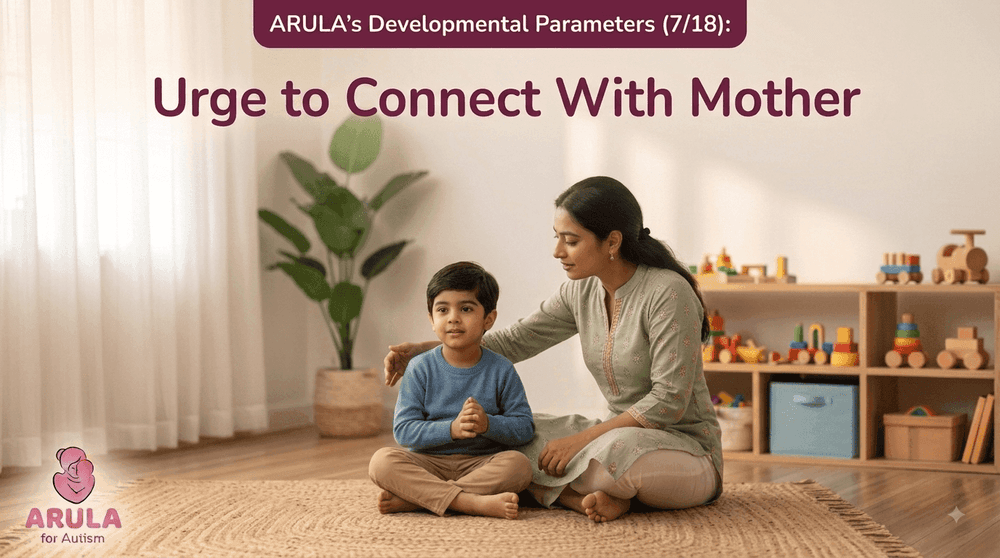
ARULA’s Developmental Parameters (7/18): Urge to Connect With Mother
ARULA views connection as a neurodevelopmental foundation, not just attachment style, and observes how children seek comfort, initiate interaction, and use caregivers for guidance. These patterns reveal internal safety and regulation, guiding gentle, developmentally informed support rather than forced connection.
AF
ARULA for Autism
· 7 min read
Why a Child’s Drive to Seek Their Mother Is Central to Emotional, Social, and Language Development
The urge to connect with the mother (or primary caregiver) is one of the most powerful and foundational forces in early childhood development. Long before a child learns to speak, follow instructions, or engage socially, they communicate through connection-seeking behaviors.
In ARULA, this parameter is not viewed as dependence or attachment style alone. It is understood as a biological and neurodevelopmental drive that shapes how a child learns, communicates, and relates to the world.
What Does “Urge to Connect With Mother” Mean?
This parameter refers to the child’s spontaneous emotional and social orientation toward the mother. It includes not only seeking the mother for physical needs, but also for emotional regulation, reassurance, and shared experience.
A healthy urge to connect is visible when a child:
seeks comfort when distressed
checks in with the mother during unfamiliar situations
shares joy, interest, or curiosity
uses the mother as a reference point for safety
This urge forms the emotional anchor from which all later social development unfolds.
What ARULA Observes in This Parameter
Understanding the Quality of a Child’s Connection With Their Mother
ARULA does not assess connection in a binary way. The focus is not on whether a child does or does not connect, but on the meaning behind the child’s connection patterns. How a child approaches their mother reveals how safe, understood, and regulated they feel internally.
Each observation provides insight into the child’s emotional world and nervous system functioning.
1. Nature of Connection: Functional vs. Relational
ARULA looks closely at why the child approaches the mother.
Some children connect only when they need something tangible—food, help, access to an object, or assistance with a task. While this shows awareness of the mother as a resource, it may indicate that emotional connection does not yet feel fully safe or rewarding.
Relational connection goes beyond needs. It includes:
seeking closeness without a clear request
sharing interest, excitement, or curiosity
approaching the mother simply to be near
This type of connection reflects emotional safety and trust. ARULA observes whether relational connection is present, emerging, or currently limited.
Initiation is a powerful indicator of internal motivation.
ARULA observes whether the child:
approaches the mother spontaneously
initiates interaction without prompts
seeks connection during neutral or positive moments
Children who initiate connection are demonstrating that they experience the mother as emotionally available and regulating. When initiation is limited, it often reflects uncertainty, past overwhelm, or difficulty reading social cues—not rejection.
3. Social Referencing: Using the Mother as an Emotional Guide
Social referencing is the child’s ability to look to the mother to understand unfamiliar or uncertain situations.
ARULA watches for:
checking the mother’s facial expression
pausing to observe the mother before acting
adjusting behavior based on the mother’s emotional cues
This behavior shows that the child:
recognises the mother as a source of emotional information
trusts her interpretation of the environment
is developing shared emotional understanding
Social referencing is a key building block for empathy and social learning.
4. Comfort-Seeking Behavior: Regulation Through Relationship
When children feel overwhelmed, they instinctively seek regulation from a trusted caregiver—if that caregiver feels safe to them.
ARULA observes:
whether the child returns to the mother during distress
how the child responds to comfort attempts
whether the mother’s presence helps reduce emotional intensity
If a child avoids comfort or struggles to settle even with support, it often indicates a nervous system that has learned to self-protect rather than co-regulate.
What These Observations Reveal
Together, these behaviors reveal:
the child’s internal sense of safety
how connection feels emotionally
how regulation is currently managed
whether the attachment system is functioning smoothly or under strain
ARULA uses this understanding to guide parents—not to label the child, but to support connection in ways that feel safe and accessible.
Why This Matters for Intervention
A child who does not yet seek emotional connection is not failing to attach. They may simply need:
slower pacing
more predictability
less pressure
better emotional attunement
ARULA tailors its support based on these observations, allowing connection to grow naturally rather than being forced.
Why the Urge to Connect Is So Important
1. Foundation for Emotional Regulation
Children regulate emotions through caregivers before they can regulate independently. When a child seeks the mother during distress, they are using the most effective regulation strategy available to them.
Repeated experiences of comfort teach the brain:
emotions are manageable
distress is temporary
support is available
This forms the basis of lifelong emotional resilience.
2. Foundation for Communication Intent
Communication begins with the desire to connect, not with words.
A child who wants to connect with their mother is more likely to:
gesture
vocalize
use facial expressions
attempt communication
Without this urge, speech and language development often stall because communication lacks emotional purpose.
3. Foundation for Social Reciprocity
Social skills do not develop in isolation. The earliest social relationship—the mother-child bond—teaches:
turn-taking
shared attention
emotional exchange
empathy
Children who feel safe connecting with their mother are more able to engage with others later.
The Neuropsychological Foundation of Mother–Child Connection
Attachment Systems in the Brain
The urge to connect is biologically driven by attachment systems involving:
the limbic system
oxytocin pathways
stress-regulation circuits
These systems motivate the child to seek proximity to the caregiver during both pleasure and distress.
Safety Before Exploration
When a child perceives the mother as a safe base, the brain allows exploration and learning. Without this felt safety, the brain remains in a protective mode, limiting curiosity and engagement.
This explains why children may appear withdrawn, avoidant, or overly independent when connection systems are underdeveloped or disrupted.
Why Some Children Show a Reduced Urge to Connect
A reduced or inconsistent urge to connect does not mean rejection or lack of attachment. It may reflect:
sensory overwhelm
difficulty interpreting emotional cues
early stress or medical challenges
neurodivergent processing styles (ASD/ADHD)
repeated experiences of misattunement
In such cases, connection may feel confusing or overwhelming rather than comforting.
Common Misconceptions
❌ “My child prefers being alone, so they don’t need connection” ✔ All children need connection; some struggle to access it safely.
❌ “Seeking the mother too much creates dependency” ✔ Secure connection builds independence over time.
❌ “Avoidance means lack of bonding” ✔ Avoidance often reflects nervous system protection.
How ARULA Strengthens the Urge to Connect With Mother
ARULA does not force connection. It creates the conditions where connection can emerge naturally.
1. Rebuilding Emotional Safety
ARULA helps mothers respond predictably and calmly, allowing the child’s nervous system to associate the mother with regulation rather than pressure.
2. Encouraging Connection Beyond Needs
Parents are guided to invite shared experiences—play, observation, quiet presence—without demands.
3. Supporting Co-Regulation
When the child is distressed, ARULA prioritizes soothing before teaching. This reinforces the mother as a source of emotional relief.
4. Respecting the Child’s Pace
Connection grows at the child’s speed. ARULA avoids rushing eye contact, affection, or interaction.
5. Turning “Avoidance” Into Strength
Children who appear independent often have strong internal focus. ARULA helps redirect this strength into relational engagement without overwhelming the child.
Signs of Progress Parents Often Notice
Over time, parents may observe:
increased proximity-seeking
more shared eye contact
spontaneous affection
checking in during new situations
improved communication attempts
These are signs that the child’s attachment system is strengthening.
Why This Parameter Matters Long-Term
The urge to connect with the mother influences:
emotional health
language development
peer relationships
learning motivation
stress resilience
Strengthening this foundation supports the entire developmental trajectory.
Conclusion: Connection Is the Root of Development
A child’s urge to connect with their mother is not a luxury—it is a biological necessity. Through this connection, children learn how to feel safe, how to communicate, and how to relate to others. When this urge is supported gently and respectfully, children gain the confidence to explore the world and engage socially.
ARULA recognises that connection cannot be taught through techniques alone. It grows through safety, consistency, and emotional attunement. By strengthening the mother–child bond, ARULA supports not just one developmental parameter, but the entire system upon which learning and wellbeing depend.