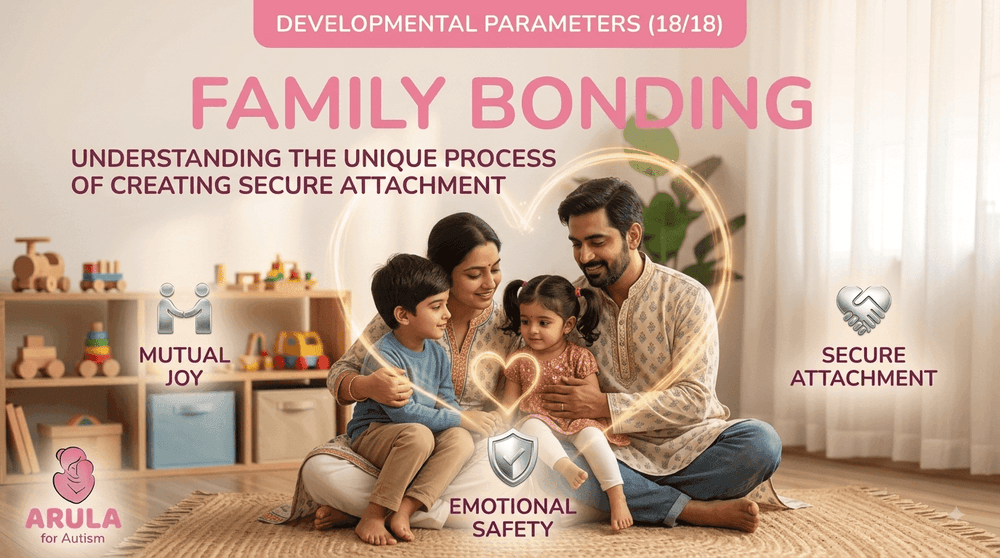
ARULA’s Developmental Parameters (18/18): Family Bonding
Family bonding refers to the quality of emotional connection, attachment, and shared experiences between a child and their family members. It encompasses the warmth, responsiveness, and mutual understanding that form the foundation of a child’s sense of security and belonging within their family unit.
AF
ARULA for Autism
· 6 min read
Definition
Family bonding refers to a child’s emotional connection with family members and the overall emotional quality of the home environment.
This includes the child’s relationship with:
Parents
Siblings
Grandparents
Extended family members
Everyday family routines and interactions
For autistic children, family bonding is not just about affection—it forms the foundation for emotional safety, regulation, communication, and development.
Understanding Family Bonding in Autistic Children
Every child develops through relationships. Long before children learn academic skills, they learn through connection—through being comforted, understood, included, and emotionally supported.
For autistic children, this becomes even more important.
Many autistic children experience the world as overwhelming or unpredictable. In these situations, the family often becomes the child’s primary source of safety and stability. A calm, emotionally supportive home can help the child feel more secure, regulated, and open to interaction.
At the same time, bonding may not always look the way families expect.
Some autistic children may not openly seek hugs, maintain eye contact, or express emotions in typical ways. This does not mean the child lacks attachment or love. Often, connection is expressed more subtly—through proximity, shared routines, familiar comfort, or small moments of trust.
Understanding these differences helps families focus less on “how bonding should look” and more on how the child experiences connection.
What We Observe
When looking at family bonding, it is important to observe the child’s comfort, participation, and emotional engagement within the family environment.
1. Interaction with Parents
Parents are usually the child’s primary emotional anchors.
We observe:
Does the child seek comfort from parents?
Do they enjoy being near them?
How does the child respond during play, routines, or emotional moments?
Some children may actively initiate interaction, while others may connect more quietly through presence or routine.
2. Relationship with Father, Siblings, and Grandparents
Bonding is not limited to the mother-child relationship.
Interactions with fathers, siblings, and grandparents can support:
Social development
Emotional flexibility
Communication opportunities
Shared play and participation
Some autistic children may feel more comfortable with certain family members than others, depending on personality, communication style, and emotional safety.
3. Comfort in Family Routines
Children often bond through predictable shared experiences.
We observe how the child participates in routines such as:
Mealtimes
Bedtime routines
Family conversations
Outings or celebrations
Play and leisure activities
A child who feels emotionally secure is often more able to participate comfortably in these routines.
4. Emotional Environment at Home
The emotional atmosphere of the home strongly affects development.
Children are sensitive to:
Stress
Conflict
Tone of voice
Emotional predictability
Caregiver regulation
A calm and supportive environment helps children feel safer and more connected.
This does not mean families must be “perfect.” What matters most is whether the child experiences the home as emotionally safe and accepting.
Why Family Bonding Is Important
Family bonding plays a major role in emotional and developmental growth.
Emotional Safety Supports Regulation
Children learn to regulate emotions through safe and responsive relationships. When caregivers respond consistently and calmly, children gradually develop greater emotional stability.
For autistic children, regulation often improves when interactions feel predictable, warm, and low-pressure.
Connection Encourages Communication
Children are more likely to communicate when they feel emotionally connected.
Many communication skills begin within relationships:
Shared attention
Turn-taking
Listening
Expressing needs
Responding socially
Strong family relationships create natural opportunities for these skills to grow.
Supportive Bonds Build Confidence
When children feel accepted and understood, they are more willing to explore, participate, and try new things.
Repeated experiences of emotional support help build:
Confidence
Trust
Security
Willingness to engage socially
Family Relationships Influence Long-Term Development
Research consistently shows that emotionally supportive family environments positively affect:
Social development
Emotional well-being
Adaptive functioning
Stress management
Children develop best when they feel emotionally connected, not pressured to perform.
Challenges Families May Experience
Family bonding can sometimes feel difficult, especially when parents are overwhelmed or unsure how to connect with their child.
Some families may experience:
Difficulty understanding the child’s emotional responses
Reduced interaction due to communication differences
Stress around behavior or routines
Sibling misunderstandings
Emotional exhaustion or guilt
It is important for families to remember that bonding does not happen through perfection. It develops gradually through repeated moments of safety, patience, and shared experience.
Even small daily interactions matter.
Supporting Family Bonding at Home
Strong family connection is built through consistent, emotionally safe interactions—not through pressure.
Simple ways to support bonding include:
Spending one-on-one time without demands
Joining the child in activities they enjoy
Creating predictable family routines
Using calm and responsive communication
Celebrating small moments of connection
Allowing the child to engage in their own way
Children often connect most deeply when they feel accepted rather than corrected constantly.
It is also important to involve the wider family when possible. Positive relationships with siblings, fathers, and grandparents can create a richer emotional environment for the child.
What to Avoid
Certain patterns can unintentionally make bonding more difficult:
Constantly correcting or directing the child
Comparing the child to siblings or peers
Forcing interaction when the child is overwhelmed
Interpreting reduced eye contact or affection as lack of attachment
Creating pressure around “normal” social behavior
Connection grows best in an atmosphere of patience and emotional safety.
What Progress Looks Like
Progress in family bonding is often subtle.
It may look like:
Sitting closer to family members
Seeking comfort during distress
Participating more in routines
Sharing enjoyment during play
Increased responsiveness or engagement
These moments are meaningful signs of trust and emotional connection.
How ARULA Methods View Family Bonding
Approaches like ARULA place strong importance on the role of family relationships in development.
Within this perspective, emotional connection is not seen as separate from learning—it is considered the foundation for it.
The ARULA method, developed by speech therapist Mayuri Ramdasi, emphasizes parent-child bonding, emotional safety, and communication within everyday life. Rather than focusing only on structured teaching, families are encouraged to build connection through daily routines, shared experiences, and responsive interaction.
The approach also recognizes that development happens more effectively when children feel emotionally secure and accepted within their home environment. Families are guided to observe the child’s comfort, reduce unnecessary pressure, and support participation gradually through natural interactions.
In this way, bonding is not treated as an “extra” part of development—it becomes the environment in which development happens.
Final Thoughts
Family bonding is not measured by how affectionate, verbal, or socially expressive a child appears.
Real connection is built through safety, consistency, trust, and shared experience.
For autistic children, feeling emotionally understood within the family can have a powerful impact on regulation, communication, confidence, and overall development.
And often, the most meaningful moments of bonding are the quiet ones—sitting together, sharing routines, playing side by side, or simply knowing that the child feels safe in the presence of the people who love them.