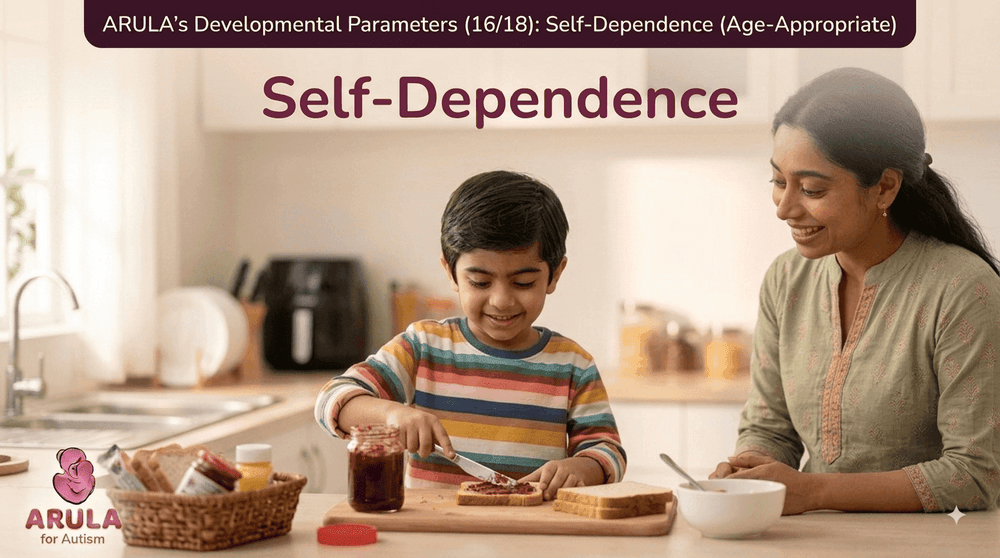
Self-dependence refers to a child’s ability to carry out age-appropriate daily activities with increasing independence. These include simple but essential routines such as dressing, maintaining personal hygiene, cleaning up after meals, and following everyday sequences.
AF
ARULA for Autism
· 6 min read
Understanding Self-Dependence as the Foundation of Everyday Functioning
Self-dependence refers to a child’s ability to carry out age-appropriate daily activities with increasing independence. These include simple but essential routines such as dressing, maintaining personal hygiene, cleaning up after meals, and following everyday sequences.
At first glance, these may appear to be basic life skills. However, in reality, self-dependence represents a complex integration of multiple developmental processes. A child who independently brushes their teeth or gets dressed is not just performing a task—they are coordinating motor skills, understanding sequences, regulating emotions, sustaining attention, and adapting to expectations.
Within the ARULA framework, self-dependence is considered a functional outcome parameter. This means it reflects how effectively a child can translate underlying abilities—such as regulation, understanding, and motor coordination—into real-life participation and independence.
Importantly, independence is not about perfection or speed. It is about a child’s growing ability to take ownership of everyday activities, with appropriate support when needed.
What ARULA Observes in Self-Dependence
ARULA looks beyond whether a child can perform a task, and instead asks: How does the child approach the task? What supports do they need? What challenges are underlying their performance?
1. Dressing Skills
Dressing is one of the earliest indicators of independence in daily life.
Understanding orientation (front vs. back, inside-out)
Choosing appropriate clothing for context (e.g., weather)
Dressing requires coordination between fine motor skills, body awareness, and sequencing abilities. For some children, difficulties may arise due to:
motor planning challenges (knowing how to perform the steps)
sensory sensitivities (discomfort with certain fabrics or textures)
frustration tolerance when tasks feel effortful
A child refusing to dress independently is often not being “difficult”—they may be overwhelmed by the demands of the task.
2. Personal Hygiene (e.g., Brushing Teeth, Washing Hands)
Hygiene routines are repetitive and structured, yet they can be surprisingly challenging.
ARULA looks at:
Ability to perform steps independently
Consistency in completing routines
Tolerance to sensory input (taste of toothpaste, feel of water, smell of soap)
These tasks involve sequencing, habit formation, and sensory processing. Children may resist hygiene routines because:
they find the sensations unpleasant
they struggle with transitions (starting and finishing tasks)
they do not yet fully understand the importance of the activity
Over time, with consistency and support, these routines can become automatic and less effortful.
3. Post-Meal Clean-Up
Cleaning up after meals is often overlooked, but it plays an important role in developing responsibility and participation.
ARULA observes:
Whether the child clears their plate or assists in small ways
Awareness of “task completion” after eating
Willingness to follow through on expectations
This area reflects not just skill, but also engagement in shared routines and social responsibility. It helps children understand that activities have a beginning, middle, and end.
4. Following Simple Routines
Daily life is built on routines—morning preparation, school readiness, bedtime sequences.
ARULA assesses:
Ability to follow 1–3 step instructions
Transitioning between activities smoothly
Completing familiar sequences with minimal prompting
Following routines requires working memory, attention, and predictability. When children struggle, it may appear as:
forgetfulness
avoidance
“not listening”
However, these behaviors often reflect processing or executive functioning difficulties, rather than intentional non-compliance.
5. Initiation and Independence
One of the most important aspects of self-dependence is not just doing, but starting.
ARULA looks at:
Whether the child begins tasks independently
Dependence on reminders or prompts
Ability to persist and complete tasks
Some children can perform tasks but do not initiate them. This may be due to:
reduced motivation
executive functioning challenges
lack of confidence
reliance on adult prompting
Initiation is a key step toward true independence.
Why Self-Dependence Is Important
1. Building Functional Independence
Self-dependence directly determines how well a child can manage everyday life demands.
As children grow, expectations increase—especially in school environments where independence is required for:
managing belongings
following routines
completing tasks without constant supervision
Developing these skills early reduces long-term reliance on caregivers and supports adaptive functioning (American Psychiatric Association, 2013).
2. Strengthening Executive Functioning
Everyday tasks are natural opportunities to build:
planning
sequencing
organization
self-monitoring
These executive functions are critical for academic success and real-world problem-solving (Diamond, 2013).
3. Supporting Emotional Development
When children are able to do things for themselves, they experience:
a sense of achievement
increased confidence
willingness to try new tasks
Repeated dependence, on the other hand, can lead to learned helplessness or low self-esteem.
4. Enhancing Social Participation
Independence allows children to:
function more comfortably in group settings
follow shared routines
engage with peers without constant adult support
This is particularly important in school environments, where independence supports inclusion and participation.
5. Promoting Regulation and Adaptability
Independent functioning reflects a child’s ability to:
tolerate expectations
manage transitions
adapt to structured environments
Difficulties in self-dependence often signal underlying challenges in regulation or sensory processing.
Common Challenges in Self-Dependence
Children may:
avoid or resist daily tasks
rely heavily on adults for simple activities
struggle to initiate or complete routines
show inconsistency (can do it one day, not the next)
become frustrated or emotionally overwhelmed
These challenges are especially common in children with:
executive functioning difficulties
sensory sensitivities
motor coordination delays
anxiety or low confidence
Understanding the reason behind the difficulty is essential before expecting independence.
How ARULA Supports Self-Dependence
ARULA focuses on supporting independence through understanding and gradual development, rather than pressure or forced compliance.
1. Breaking Tasks into Smaller Steps
Large tasks are simplified into manageable steps, making them easier to learn and repeat. This reduces overwhelm and supports skill acquisition.
2. Creating Consistent and Predictable Routines
When routines are consistent, children begin to:
anticipate what comes next
feel more secure
rely less on external prompting
Predictability supports both learning and regulation.
3. Gradual Release of Support
Instead of expecting immediate independence, ARULA encourages:
guided participation
partial independence
eventual autonomy
This ensures that the child builds confidence at their own pace.
4. Addressing Sensory and Motor Barriers
Sometimes the challenge is not motivation, but discomfort or difficulty.
ARULA considers:
sensory preferences (e.g., clothing textures)
motor skill support (adaptive tools, simplified tasks)
Removing these barriers makes independence more achievable and less stressful.
5. Encouraging Initiation and Choice
Giving children opportunities to:
make small decisions
start tasks independently
take responsibility
This builds ownership and motivation.
6. Reinforcing Effort and Progress
Instead of focusing on perfect outcomes, ARULA emphasizes:
effort
attempts
gradual improvement
This creates a positive learning environment where children feel safe to try.
Conclusion
Self-dependence is not just about completing tasks—it is about a child’s ability to engage with daily life in a confident, regulated, and meaningful way.
Within the ARULA framework, independence is understood as a developmental journey, shaped by regulation, support, and opportunity. By focusing on the underlying processes and providing appropriate scaffolding, children can gradually build the skills needed for everyday functioning.
As self-dependence improves, children often show growth in:
confidence
participation
adaptability
overall quality of life
Ultimately, fostering independence is about helping children move toward greater autonomy, dignity, and real-world readiness.
About ARULA
ARULA (Assessment of Regulation, Understanding, Learning, and Adaptation) is a holistic developmental framework designed to understand and support children across interconnected domains.
It emphasizes:
regulation as the foundation of development
understanding behavior through underlying processes
child-centered and functional assessment
individualized, practical interventions
By focusing on key areas such as sleep, eating, and self-dependence, ARULA aims to support children in developing sustainable independence and meaningful participation in everyday life.