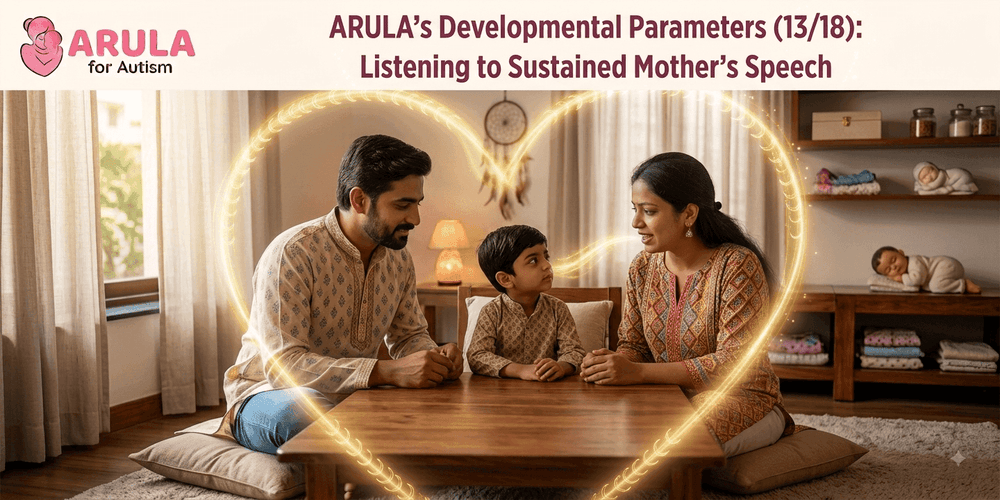
ARULA’s Developmental Parameters (13/18): Listening to Sustained Mother’s Speech
Listening to sustained speech refers to a child’s ability to attend to and process spoken language over a period of time without becoming overwhelmed, distracted, or disengaged. This includes listening to stories, following extended instructions, and remaining engaged during conversation. This parameter goes beyond simple auditory awareness. In ARULA, this skill is considered a critical bridge between basic listening and higher-level language comprehension.
AF
ARULA for Autism
· 5 min read
Building Auditory Endurance, Language Comprehension, and Emotional Connection
Listening to sustained speech refers to a child’s ability to attend to and process spoken language over a period of time without becoming overwhelmed, distracted, or disengaged. This includes listening to stories, following extended instructions, and remaining engaged during conversation.
This parameter goes beyond simple auditory awareness. While auditory awareness reflects whether a child notices sound, sustained listening reflects whether the child can remain engaged with meaningful speech over time. It requires attention, regulation, language processing, and emotional connection working together.
In ARULA, this skill is considered a critical bridge between basic listening and higher-level language comprehension.
What Is Sustained Listening?
Sustained listening includes:
Listening to short stories or narratives
Following multi-step instructions
Maintaining attention during conversation
Tolerating longer verbal input without disengagement
Processing information across time (not just single words)
This skill develops gradually and depends heavily on both neurological readiness and relational context.
ARULA evaluates how the child engages with prolonged speech, not just whether they hear it.
1. Duration of Listening
How long can the child attend to speech?
Does attention drop quickly or gradually?
Does the child require frequent prompts to stay engaged?
Short listening spans may indicate limited auditory endurance or attentional fatigue.
2. Quality of Engagement
Is the child actively listening (eye gaze, stillness, subtle responses)?
Do they show signs of processing (facial changes, gestures)?
Are they passively present or meaningfully engaged?
Engagement quality is often more important than duration alone.
3. Signs of Overload or Shutdown
Does the child look away, move excessively, or disengage?
Do they become irritable or distracted during longer speech?
Do they avoid situations involving sustained listening?
These behaviors may reflect auditory or cognitive overload rather than disinterest.
4. Response to Instructions and Stories
Can the child recall or act on what was said?
Do they follow sequences or only isolated commands?
Do they retain information across sentences?
This reflects integration of attention, memory, and comprehension systems.
Neurodevelopmental Foundations of Sustained Listening
Listening to prolonged speech requires coordination across multiple brain systems.
1. Auditory Processing Systems
The temporal lobes process incoming speech sounds and organize them into meaningful units. Efficient auditory processing allows children to distinguish important speech from background noise (Kuhl, 2004).
2. Attention Networks
Sustained listening depends on attention systems that allow the brain to remain focused over time. These systems involve frontal and parietal networks responsible for maintaining and shifting attention appropriately (Sarter et al., 2001).
3. Working Memory
Working memory allows children to hold and manipulate information while listening. Without this, children may hear words but struggle to connect them into meaningful sequences (Gathercole & Alloway, 2008).
4. Language Comprehension Systems
Understanding sustained speech requires integration of vocabulary, grammar, and contextual meaning. Comprehension develops as children learn to process longer and more complex sentences (Nation, 2005).
5. Emotional Regulation Systems
A child must be regulated to sustain attention. Anxiety, sensory overload, or fatigue can reduce listening capacity significantly.
Why Sustained Listening Is Important
1. Foundation for Language Development
Language is learned through repeated exposure to meaningful speech. The ability to listen for longer periods increases opportunities for vocabulary growth and sentence understanding (Kuhl, 2004).
2. Academic Readiness
Classroom learning relies heavily on sustained listening:
Teacher instructions
Story comprehension
Verbal explanations
Weak auditory endurance can impact learning even when intelligence is intact.
3. Improved Comprehension
Listening over time allows children to:
understand sequences
grasp cause-and-effect relationships
interpret narratives
4. Strengthening Parent–Child Bond
Listening to a caregiver’s voice supports emotional connection. Shared activities like storytelling build trust, predictability, and relational security.
Why Some Children Struggle With Sustained Listening
Difficulties may arise due to:
limited auditory tolerance
attention regulation challenges
working memory limitations
sensory sensitivities
language comprehension delays
emotional dysregulation
In many cases, children are not refusing to listen—they are unable to sustain processing due to cognitive or sensory overload.
Developmental Progression
Sustained listening typically develops in stages:
Brief attention to voice or sound
Listening to short phrases or commands
Following simple instructions
Listening to short stories
Sustained engagement with longer narratives
Progress is gradual and influenced by emotional and environmental factors.
How ARULA Strengthens Listening to Sustained Speech
Builds Emotional Safety First Children are more likely to listen when they feel secure. ARULA emphasizes calm, pressure-free interaction.
Uses Mother’s Voice as a Regulating Tool The caregiver’s voice becomes associated with comfort and predictability, increasing listening tolerance.
Gradually Increases Listening Duration Speech exposure is extended slowly, ensuring the child remains regulated and engaged.
Simplifies Language Initially Short, clear sentences are used before increasing complexity.
Supports Active Engagement Parents are guided to include gestures, expressions, and pauses to maintain attention.
Avoids Overloading the Child ARULA emphasizes pacing and responsiveness to prevent shutdown.
Encourages Interactive Storytelling Stories are used as a natural way to build listening endurance and comprehension.
Strengthens Attention and Working Memory Indirectly Through structured interaction, the child’s capacity to hold and process information improves over time.
Conclusion
Listening to sustained speech is a foundational developmental skill that supports language comprehension, academic readiness, and emotional connection. It reflects the brain’s ability to remain engaged with meaningful input over time, integrating attention, memory, and language systems.
When children struggle with sustained listening, it often reflects underlying challenges in regulation, processing, or attention—not a lack of willingness. By creating a safe, responsive, and structured listening environment, ARULA helps children gradually build auditory endurance and deepen their capacity for understanding.
As listening improves, communication, learning, and connection naturally follow.