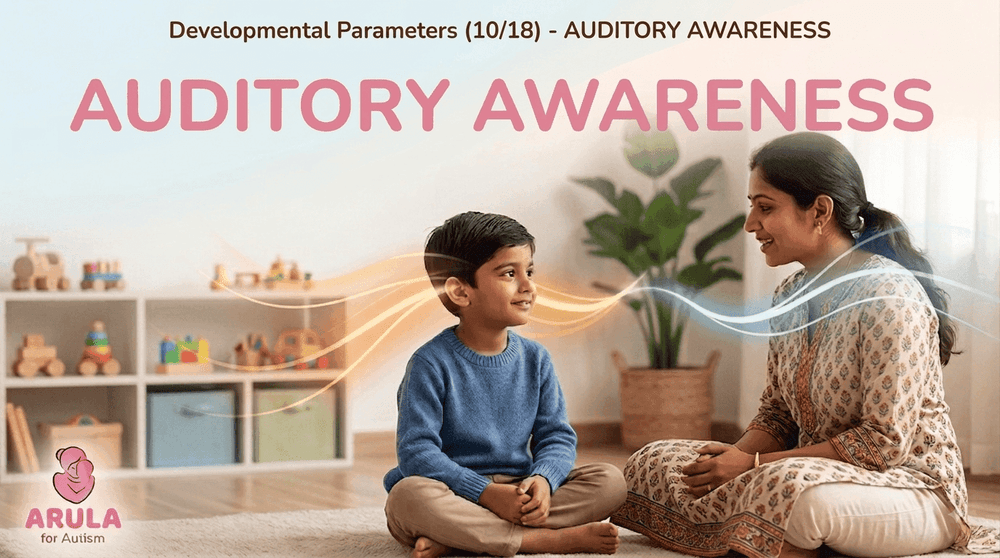
Auditory awareness is a critical developmental parameter that ARULA closely monitors. It refers to a child’s ability to perceive, process, and respond to sounds in their environment. This parameter is essential for communication development, as it lays the foundation for understanding language and engaging in social interactions.
AF
ARULA for Autism
· 5 min read
Listening Readiness as the Foundation of Communication, Safety, and Learning
Auditory awareness refers to a child’s natural and spontaneous response to sounds in their environment. It is not simply about whether a child can hear. It reflects whether the child’s brain notices, processes, and meaningfully reacts to sound.
In early development, auditory awareness forms the groundwork for listening, language comprehension, social engagement, and environmental safety. Before a child can follow instructions, respond to questions, or engage in conversation, they must first demonstrate that their nervous system is registering and orienting to sound.
ARULA treats auditory awareness as a foundational readiness indicator rather than a surface behavior.
Hearing refers to the physical ability of the ear to detect sound.
Auditory awareness refers to the brain’s ability to register, orient to, and interpret that sound.
A child may pass a hearing test yet still appear “not to listen.” In many cases, the issue lies in how the brain filters and prioritizes sound, not in the ears themselves.
What ARULA Observes
ARULA carefully examines patterns rather than isolated incidents.
1. Response to Name
Responding to one’s name is one of the earliest markers of social auditory awareness. It demonstrates:
sound detection
attention shifting
social orientation
recognition of self-relevance
Inconsistent response to name may reflect:
attentional differences
sensory overload
difficulty filtering competing stimuli
social processing differences
It does not automatically indicate defiance.
2. Orientation to Environmental Sounds
Does the child turn toward:
a doorbell?
a sudden noise?
a dropped object?
a familiar voice?
This orientation reflex reflects the brain’s ability to detect novelty and assign importance to sound.
A reduced orienting response may indicate that the child’s nervous system is either:
under-responsive (sound does not register as significant), or
over-responsive (sound feels overwhelming and is blocked out).
3. Alertness to Verbal Cues
When spoken to, does the child:
shift gaze?
pause activity?
show subtle body acknowledgment?
change behavior in response?
These micro-responses are often more important than dramatic reactions.
ARULA looks for signs that the brain is recognizing spoken language as meaningful input.
The Neurodevelopmental Foundation of Auditory Awareness
Auditory awareness involves coordination across several brain systems.
1. Brainstem and Orienting Reflex
The brainstem initiates the automatic orienting response to sound. This primitive reflex allows infants to turn toward voices and sudden noises.
If this system is underactive, a child may not consistently orient to sound. If overactive, the child may startle excessively or avoid auditory input.
2. Auditory Cortex Processing
The temporal lobes decode sound patterns. This includes:
distinguishing speech from background noise
recognizing familiar voices
identifying emotional tone
Efficient processing allows the child to prioritize relevant sounds.
3. Reticular Activating System (Alertness Regulation)
This system regulates wakefulness and attentional readiness. If under-aroused, the child may seem disengaged. If over-aroused, they may struggle to filter competing sounds.
Listening readiness requires optimal arousal—not too high, not too low.
4. Social Brain Networks
Responding to name involves more than sound detection. It activates social processing circuits that assign personal relevance.
When social processing networks develop differently, response to name may be inconsistent despite intact hearing.
Why Auditory Awareness Is So Important
1. Foundation for Language Development
Before understanding words, a child must:
notice speech
orient to it
attend long enough to process it
Listening readiness precedes comprehension.
2. Environmental Safety
Auditory awareness helps children respond to:
warnings
changes in environment
danger cues
Reduced responsiveness can impact safety awareness.
3. Social Engagement
Conversation begins with noticing someone speaking. If auditory awareness is inconsistent, social reciprocity becomes more difficult.
4. Academic Readiness
Classroom learning depends heavily on auditory input. Listening readiness predicts the ability to follow instructions and process verbal information.
Why Some Children Show Reduced Auditory Awareness
Several factors may influence this parameter:
sensory processing differences
chronic overstimulation
anxiety or hypervigilance
attentional regulation differences
limited early language exposure
social communication differences
In many cases, children are not ignoring sound—they are overwhelmed by it or unable to prioritize it.
Developmental Progression of Auditory Awareness
Healthy progression may include:
Startle or orient reflex to loud sounds
Turning toward familiar voices
Recognizing name consistently
Responding to simple verbal cues
Sustained listening during short interactions
Progress may be gradual and influenced by emotional regulation.
How ARULA Strengthens Auditory Awareness
ARULA approaches auditory awareness by improving the conditions that make listening possible.
1. Regulation Before Instruction
Children listen better when calm. ARULA prioritizes nervous system regulation before expecting auditory compliance.
2. Reducing Environmental Noise
Minimizing competing sounds allows the brain to focus on meaningful input.
3. Increasing Personal Relevance
ARULA encourages using the child’s interests and emotional engagement to strengthen sound salience.
4. Strengthening Mother–Child Vocal Connection
When the caregiver’s voice becomes a source of comfort and predictability, auditory awareness increases naturally.
5. Avoiding Over-Prompting
Repeatedly calling a child’s name can desensitize them. ARULA teaches strategic, intentional calling paired with meaningful engagement.
Conclusion
Auditory awareness is more than hearing—it is the brain’s readiness to register and respond to sound. It forms the foundation for language, safety, learning, and social engagement.
When auditory awareness is inconsistent, it often reflects sensory regulation, attention, or social processing differences rather than unwillingness. By addressing emotional safety, reducing overload, and strengthening relational engagement, listening readiness can improve naturally.
ARULA recognizes that meaningful listening begins not with louder instructions, but with a regulated nervous system and a safe, responsive environment.