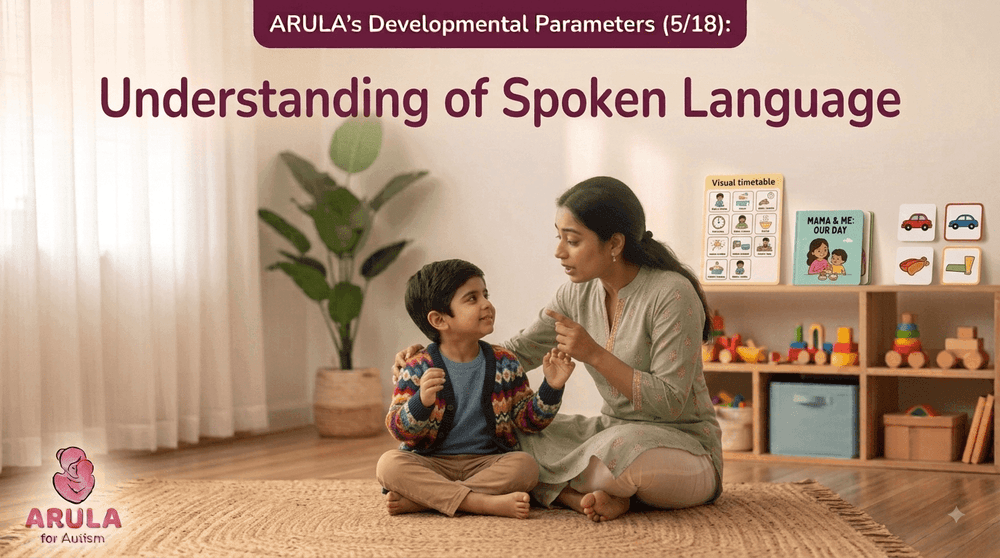
ARULA’s Developmental Parameters (5/18): Understanding of Spoken Language
Understanding spoken language is one of the most important developmental parameters in ARULA. It is not just about hearing words, but about how the child’s nervous system processes and responds to auditory information. This article explains what understanding spoken language means in ARULA, why it matters for development, how it is assessed, and how ARULA supports its growth in a way that is natural, respectful, and effective.
AF
ARULA for Autism
· 12 min read
Why Language Comprehension Must Develop Before Speech
Understanding spoken language is one of the most essential foundations of communication, yet it is often overshadowed by concerns about speech. Many parents worry about when their child will start talking, but neuroscience consistently shows that language comprehension must develop before expressive speech can emerge in a meaningful and functional way.
Within ARULA, understanding spoken language is viewed not as a passive skill, but as an active developmental process shaped by regulation, attention, listening capacity, and emotional safety.
What Does “Understanding of Spoken Language” Mean?
Understanding spoken language refers to a child’s ability to process, interpret, and respond appropriately to what is said to them. This goes beyond recognising familiar sounds or reacting to tone.
This skill includes:
responding to one-step and two-step commands
understanding daily instructions and routines
distinguishing between simple and more complex language
processing spoken words without relying solely on gestures
A child may hear perfectly well but still struggle to understand spoken language if attention, regulation, or auditory processing systems are still developing.
Why Understanding Comes Before Speech
In typical development, children understand far more language than they can express. This internal comprehension allows the brain to:
When comprehension is weak, expressive speech often remains limited, delayed, or repetitive. Pushing speech before understanding is established can increase frustration and reduce a child’s motivation to communicate.
The Neuropsychological Foundation of Spoken Language Understanding
How the Brain Learns to Make Sense of Words
Understanding spoken language is not a single skill that switches on at a certain age. It is the result of multiple brain systems developing together over time. For a child to understand what is being said, their brain must first be able to hear sounds accurately, focus on them, attach meaning to them, and hold them in mind long enough to act on them.
When any of these systems are still developing, language may be heard but not fully understood.
1. Auditory Processing: Hearing vs. Understanding
The first step in understanding language is not speech itself, but how the brain processes sound.
Some children hear sounds clearly but struggle to:
separate speech from background noise
process fast or complex sentences
recognise subtle differences between words
When auditory processing is immature, spoken language can feel confusing or overwhelming. The child may appear not to listen, when in reality their brain is working very hard just to decode the sounds.
2. Attention and Regulation: The Brain Must Be Ready to Listen
Understanding language requires the brain to be in a calm, alert state. If a child is dysregulated—overstimulated, anxious, tired, or emotionally distressed—the brain prioritises survival over comprehension.
In these moments:
words may be heard but not processed
instructions may be missed
multi-step language may feel impossible
This explains why children often understand language better when they feel emotionally safe and regulated.
3. Language Processing Areas: Connecting Words to Meaning
Once sounds are processed and attention is available, the brain must link words to meaning. This happens primarily in the temporal regions of the brain.
These areas help the child:
recognise familiar words
understand what words refer to
build internal vocabulary
interpret simple versus complex sentences
These networks develop through repeated, meaningful exposure, not through drills or pressure.
4. Working Memory and Sequencing: Holding Language in Mind
Understanding spoken language—especially instructions—requires the brain to hold information temporarily and process it in the correct order.
This is why:
one-step commands are easier than two-step commands
long sentences are harder to follow
fast speech reduces comprehension
Working memory develops gradually and improves with maturation and emotional safety.
5. Emotional Meaning and Social Context
Language is not just about words—it is also about tone, intention, and context.
Children understand language better when:
it is spoken with warmth and predictability
the speaker is emotionally connected
the message matches the situation
A calm, familiar caregiver voice supports both comprehension and learning.
Why Some Children Struggle With Understanding Language
When a child has difficulty understanding spoken language, it is rarely due to lack of intelligence or effort. In most cases, it reflects how the child’s brain is processing information in that moment. Understanding language is a complex task that depends on several systems working together, and when one or more of these systems is under strain, comprehension can become difficult.
1. Sensory Overload Makes Language Hard to Process
Many children experience the world as noisy, visually busy, or unpredictable. When the brain is overloaded by sensory input, it has fewer resources available to process spoken language.
In these situations:
words may be heard but not understood
instructions may feel confusing
the child may appear to ignore speech
This does not mean the child is not listening. It means their brain is prioritising managing sensory input over processing language.
2. Regulation and Emotional State Strongly Affect Comprehension
A child’s ability to understand language depends on their emotional and physiological state. When a child is anxious, frustrated, overtired, or dysregulated, their brain shifts into survival mode.
In this state:
comprehension drops significantly
multi-step language becomes overwhelming
even familiar instructions may be missed
This explains why many children understand language better in calm, predictable environments and struggle during stress.
3. Immature Auditory Processing Can Limit Understanding
Some children hear sounds clearly but struggle to process spoken language efficiently. Fast speech, complex sentences, or background noise can overwhelm auditory processing systems.
This may look like:
delayed responses
frequent requests for repetition
misunderstanding instructions
These challenges often improve with time, support, and clear, paced language.
4. Attention and Working Memory Are Still Developing
Understanding language requires holding words in mind long enough to interpret meaning. Young children and many neurodivergent children have developing attention and working memory systems.
As a result:
one-step instructions are easier than multi-step ones
long explanations are difficult to follow
attention may drift before meaning is fully processed
This is developmental, not defiant.
5. Language May Be Too Complex for the Child’s Current Level
Adults often overestimate how much language a child can process. Long sentences, abstract words, or rapid instructions can overwhelm the child’s language system.
Children understand best when language is:
simple
concrete
matched to their developmental level
Simplifying language does not limit learning—it supports it.
6. Emotional Safety Influences Willingness to Listen
Children understand language better when they feel emotionally safe and connected to the speaker. If interactions feel pressured, corrective, or demanding, children may tune out language as a protective response.
A calm, attuned caregiver voice increases both attention and comprehension.
7. Language Exposure Has Been Inconsistent or Stressful
Some children have had limited opportunities for calm, responsive language exposure due to:
frequent stress
medical challenges
high-pressure environments
repeated demands to perform
Language learning thrives in low-pressure, responsive interactions.
Why Understanding Spoken Language Matters for Development
Communication: Understanding allows intentional communication, even before speech.
Emotional Regulation: Clear understanding reduces frustration and anxiety.
Learning Readiness: Comprehension supports play, routines, and later academics.
Social Connection: Understanding language enables meaningful interaction.
Common Misconceptions About Language Development
Misunderstandings about how language develops are extremely common and often add unnecessary stress for parents. These misconceptions can also lead to approaches that unintentionally slow progress. Clarifying them helps parents respond with confidence and patience rather than pressure.
Misconception 1: “If my child isn’t speaking, they don’t understand.”
One of the most widespread myths is that understanding and speaking develop at the same pace. In reality, receptive language (understanding) almost always develops before expressive language (speaking).
Many children understand far more than they can show. They may:
follow routines without words
respond through actions rather than speech
show understanding only in calm states
Limited speech does not equal limited comprehension. Assuming otherwise can lead adults to oversimplify interactions or stop talking altogether, which reduces language exposure.
Misconception 2: “Repeating words means my child understands them.”
Some children repeat words or phrases they hear, a pattern often called echolalia. While repetition can be part of language development, it does not always indicate full understanding.
Echolalia can serve different purposes:
processing language
self-regulation
practicing sounds
communicating when original language is not yet accessible
True understanding is seen when a child can use language appropriately and flexibly, not just repeat it.
Misconception 3: “I should make my child talk to help language develop.”
Pressure to speak often comes from concern, but it can backfire. When a child is not ready for expressive language, being pushed to talk can increase anxiety and reduce willingness to communicate.
Language develops best when:
understanding is supported first
communication attempts are accepted in all forms
the child feels safe rather than tested
Speech emerges when the brain is ready, not when it is forced.
Misconception 4: “More words and longer sentences will help my child understand.”
Using complex language with a child who is still developing comprehension can overwhelm the auditory and cognitive systems. This often leads to confusion or withdrawal rather than learning.
Children understand best when language is:
clear
slow
emotionally attuned
matched to their developmental level
Simplicity supports understanding; complexity can come later.
Misconception 5: “If my child understands at home, they should understand everywhere.”
Parents are often confused when a child understands language well at home but struggles in other environments. This does not mean the child is being inconsistent or stubborn.
Understanding is strongly influenced by:
emotional safety
sensory load
familiarity of the speaker
noise and distractions
A child may understand far less when overwhelmed, even if their underlying language ability is the same.
Misconception 6: “Language delays mean low intelligence.”
Language development and intelligence are not the same. Many children with language delays show strong non-verbal reasoning, problem-solving skills, and emotional awareness.
A delay in understanding or expressing language reflects developmental timing, not cognitive potential.
Why Correcting These Misconceptions Matters
When misconceptions guide adult responses, children may experience:
unnecessary pressure
reduced motivation to communicate
increased frustration
emotional withdrawal
When parents understand how language truly develops, they can:
support comprehension first
reduce stress around speech
respond more effectively to their child’s needs
This understanding creates the conditions in which language can grow naturally.
How ARULA Strengthens Understanding of Spoken Language
A Developmental, Mother-Led Approach
ARULA strengthens spoken language understanding by working with how the child’s brain naturally learns to listen and make meaning. Instead of pushing speech or testing comprehension, ARULA focuses on building the conditions in which understanding can grow safely and steadily.
This approach recognises that comprehension improves when the child feels regulated, connected, and not under pressure.
1. Listening Is Supported Before Language Is Expected
ARULA does not begin by asking children to respond verbally. Children are first supported to listen without demand.
This means:
no pressure to answer questions
no insistence on repetition
no correction when responses are delayed or non-verbal
When listening feels safe, the brain becomes more open to processing language.
2. Regulation Comes Before Instruction
A child cannot understand language when their nervous system is overwhelmed. ARULA helps parents recognise when the child is:
overstimulated
anxious
fatigued
emotionally dysregulated
Parents are guided to first help the child settle before giving instructions or explanations. This dramatically improves comprehension because the brain is no longer in a defensive state.
3. Language Is Matched to the Child’s Developmental Level
ARULA helps parents adjust their language so it is understandable rather than impressive.
This includes:
shorter sentences
slower pacing
fewer words with clearer meaning
avoiding unnecessary explanations
As understanding improves, language complexity increases naturally.
4. The Mother’s Voice as a Primary Learning Tool
The mother’s voice plays a powerful role in ARULA’s approach. A familiar, emotionally attuned voice helps regulate attention and makes language easier to process.
Parents are guided to:
speak calmly and predictably
use warm, consistent tone
narrate actions instead of giving commands
maintain emotional connection while speaking
This helps language feel safe rather than demanding.
5. Language Is Embedded in Everyday Life
ARULA avoids isolated drills. Instead, spoken language is woven into daily routines where meaning is clear.
Examples include:
narrating dressing or meal routines
describing actions during play
pairing words with predictable outcomes
This helps the brain connect words to real experiences.
6. Repetition Without Pressure
Children need repeated exposure to language, but repetition in ARULA is natural and non-demanding.
Parents repeat key words and phrases:
without asking for imitation
without correcting
without testing understanding
Over time, repeated exposure strengthens comprehension quietly and steadily.
7. Communication Is Accepted in All Forms
ARULA values gestures, sounds, facial expressions, and actions as valid communication.
By responding meaningfully to these forms, parents show the child that:
communication is effective
they are understood
there is no rush to speak
This often leads to increased attempts at communication.
8. Understanding Is Allowed to Develop Before Speech
ARULA does not rush expressive language. As comprehension strengthens, many children begin to:
follow instructions more easily
respond appropriately
initiate interaction
attempt words spontaneously
Speech emerges when the child’s brain is ready, supported by a strong foundation of understanding.
Conclusion: Why Understanding Spoken Language Changes Everything
Understanding spoken language is not a secondary skill—it is the foundation upon which all meaningful communication is built. Children cannot be expected to speak, respond, or follow instructions if their brains are not yet able to process language calmly and consistently.
Language comprehension depends on regulation, attention, auditory processing, memory, and emotional safety working together. When any of these systems are under strain, understanding drops—regardless of intelligence or effort.
Pressuring speech before comprehension is established often increases frustration and anxiety, while slowing down and supporting understanding creates confidence and readiness. Children learn language best when they feel safe, connected, and unhurried.
True progress in communication is seen not in forced responses, but in improved listening, reduced frustration, better engagement, and spontaneous attempts to connect. These changes signal that the brain is building the foundations required for expressive language to emerge naturally.
ARULA supports families by shifting the focus from “Why isn’t my child talking?” to “What does my child’s brain need in order to understand?” Through a mother-led, regulation-based approach, ARULA helps parents create the conditions where language comprehension can grow steadily and sustainably.
By strengthening understanding first, ARULA allows speech to emerge as a natural outcome—rooted in connection, confidence, and developmental readiness.