Sitting tolerance is often misunderstood as a simple behavioral expectation. In reality, it is a complex developmental skill that reflects a child’s ability to regulate their body, attention, and emotions simultaneously. This article explores what sitting tolerance truly involves, why it can be difficult for many children, and how strengthening it supports learning and social participation.
AF
ARULA for Autism
· 10 min read
Why the Ability to Sit Is a Developmental Skill, Not a Measure of Obedience
Sitting tolerance is often treated as a behavioral expectation—something children should simply be able to do if they are “ready” or “well behaved.” From a neurodevelopmental perspective, however, sitting tolerance reflects a child’s ability to regulate their body, attention, and emotions simultaneously. For many autistic children, children with ADHD, or children with developmental delays, this skill is still under construction.
Understanding sitting tolerance through a developmental lens helps caregivers move away from pressure and toward support. This article explains what sitting tolerance truly involves, why it can be difficult, how it develops in the brain, and why strengthening it supports learning and social participation.
What Is Sitting Tolerance? Understanding the Full Picture
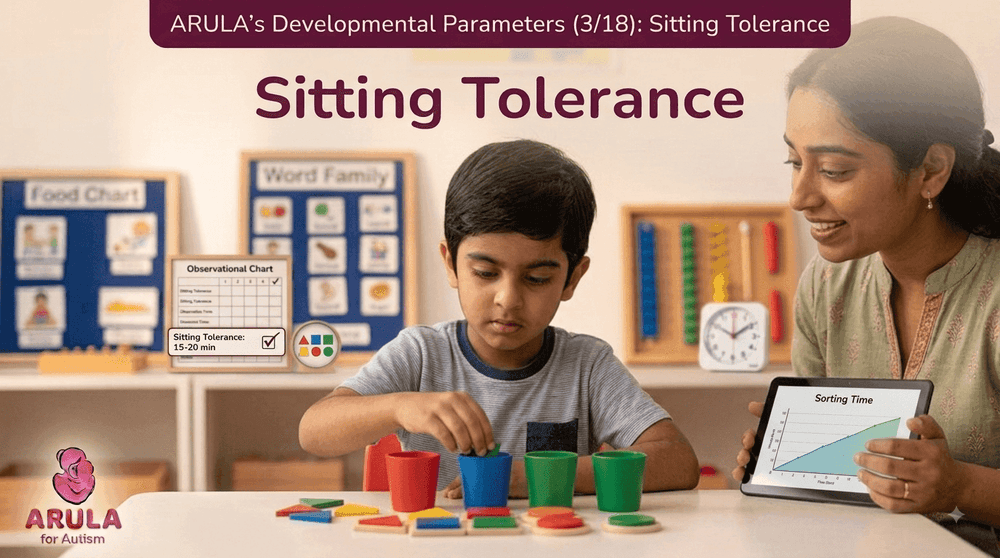
Sitting tolerance is the ability to remain seated meaningfully during an activity. Meaningful sitting does not require stillness. A child may shift position, fidget, rock slightly, or change posture while still being engaged and regulated.
A child with limited sitting tolerance may:
Sit briefly and then move away
Sit only for preferred activities
Sit but appear restless, irritable, or dysregulated
Leave the activity when sensory input increases
These patterns are not signs of laziness, defiance, or poor discipline. They usually reflect immature regulation systems, unmet sensory needs, or cognitive overload.
1. Regulation While Sitting: Stillness Requires Safety
For a child to remain seated, their nervous system must feel safe and organized. Many children rely on movement to regulate their arousal level. When movement is restricted too early, the nervous system may become dysregulated.
Children may struggle to sit because:
Their body feels over-activated or under-activated
Stillness increases anxiety or discomfort
They need movement to maintain alertness
Sensory input in the environment is overwhelming
Research on self-regulation shows that motor activity is a primary way young children regulate physiological and emotional states (Porges, 2011; Feldman, 2017). Forcing stillness before regulation is established often reduces attention rather than improving it.
2. Attention, Interest, and Cognitive Load
Sitting tolerance is tightly linked to attention span. A child can only sit as long as their brain can remain engaged.
When a child repeatedly leaves their seat, it may indicate:
The task is developmentally too advanced
Instructions are too long or abstract
The activity lacks emotional connection
The duration exceeds the child’s current capacity
Attention develops gradually and depends on motivation, predictability, and emotional connection. Neurodevelopmental research shows that sustained attention relies on prefrontal networks that mature slowly throughout early childhood (Posner & Rothbart, 2007).
3. Sensory Processing and Body Awareness
Sitting upright requires continuous sensory feedback from the body. Many autistic children and children with ADHD show differences in:
Proprioception (knowing where the body is in space)
Vestibular processing (balance and movement)
Tactile sensitivity
As a result, sitting can feel physically uncomfortable, effortful, or disorganizing. Children may stand, pace, rock, or leave their seat to recalibrate their sensory system.
Studies on sensory processing differences in autism highlight that movement-seeking or movement-avoiding behaviors are often attempts at self-regulation, not avoidance of tasks (Marco et al., 2011).
What ARULA Observes When Assessing Sitting Tolerance
ARULA evaluates sitting tolerance within real-life interactions, not formal testing situations. Observations focus on:
Duration of seated engagement during meaningful activities
Emotional regulation while seated
Triggers for leaving the seat (hyperactivity, sensory overload, boredom, fatigue)
The child’s ability to return to the activity after movement
Whether movement increases or decreases engagement
These observations help distinguish between:
Regulation difficulties
Attention limitations
Sensory needs
Task mismatch
This allows support strategies to be tailored accurately to the child’s developmental profile.
The Neuropsychological Foundation of Sitting Tolerance
Why Sitting Is a Brain Skill, Not a Behavior
For a child to sit comfortably and stay engaged, several parts of the brain must work together smoothly. Sitting tolerance is not controlled by a single “attention center.” Instead, it depends on how well the brain can organize the body, manage movement, regulate emotions, and stay mentally engaged at the same time.
When one or more of these systems is still developing, sitting can feel genuinely difficult — even distressing — for the child.
Below is a simplified explanation of the main brain systems involved.
1. The Prefrontal Cortex: Staying With an Activity
The prefrontal cortex is the part of the brain responsible for attention, impulse control, and staying focused on a task. This area develops slowly throughout childhood and into early adulthood.
When this system is still immature:
the child may get distracted easily
sitting may feel boring or tiring
the child may act before thinking
the child may struggle to stay seated even when they want to
This is not a lack of effort. The brain is still learning how to hold attention while the body is still.
2. The Cerebellum: Holding the Body Upright
The cerebellum helps control posture, balance, and smooth movement. Sitting upright actually requires continuous effort from this part of the brain.
If the cerebellum is working harder than usual:
sitting can feel physically uncomfortable
the child may slump, lean, or constantly change positions
remaining seated may be more tiring than moving
For these children, getting up is not avoidance — it is relief.
3. The Basal Ganglia: Managing the Need to Move
The basal ganglia help regulate movement and control how much the body wants to move.
When this system is less efficient:
the child may feel an internal “urge” to move
fidgeting or standing up helps release tension
staying still can feel almost impossible
This is why many children move in order to pay attention, not because they are being disruptive.
4. The Autonomic Nervous System: Feeling Calm Enough to Sit
The autonomic nervous system controls whether the body feels calm, alert, or overwhelmed. If this system is out of balance, the child may feel:
restless
anxious
overstimulated
emotionally unsettled
In this state, sitting still can increase discomfort rather than improve focus. The child’s body is trying to protect itself by moving.
5. Sensory Integration: Feeling Comfortable in the Body
Sitting also depends on how well the brain processes sensory information from the body.
Some children have difficulty sensing:
where their body is in space
how much pressure they need to feel stable
how to stay grounded without movement
These children may seek movement, change positions frequently, or leave their seat to help their body feel organised.
Why All of This Matters
When we understand sitting tolerance as a neurodevelopmental skill, not a behavioral choice, our response changes.
Instead of asking:
“Why won’t my child sit?”
We begin to ask:
“What is making sitting hard for their brain and body right now?”
As regulation improves, sensory systems mature, and emotional safety increases, sitting tolerance emerges naturally. It cannot be rushed, trained, or forced without creating stress.
Why Sitting Tolerance Matters for Development
Learning and Academic Readiness
Many learning environments require short periods of seated engagement. Sitting tolerance supports participation in structured activities, listening to instructions, and completing tasks.
Social Participation
Group activities, circle time, meals, and conversations often require remaining seated long enough to engage meaningfully with others.
Communication Development
Children learn language and social rules best when they can remain present long enough to listen, process, and respond.
Self-Regulation and Flexibility
The ability to alternate between movement and stillness supports emotional resilience and adaptability across settings.
Examples of Positive Changes When Sitting Tolerance Improves
Parents often observe:
Longer engagement during play and learning
Reduced frustration during seated tasks
Improved listening during stories or conversations
Smoother transitions between activities
Increased participation in group settings
These changes reflect growing regulation and cognitive readiness—not forced compliance.
How ARULA Strengthens Sitting Tolerance
ARULA approaches sitting tolerance as a capacity that emerges from regulation, connection, and readiness, not as a behavior that must be trained or enforced. The mother-led framework recognises that a child’s ability to sit meaningfully depends on how safe, regulated, and emotionally connected they feel in their body and environment.
Rather than asking “Can the child sit?”, ARULA asks: “What does the child’s nervous system need in order to sit?”
Below are the core ways ARULA supports the development of sitting tolerance.
1. Regulation Comes Before Expectation
ARULA does not expect sitting until the child’s nervous system shows signs of readiness. Many children struggle to sit because their bodies are either:
over-aroused (restless, impulsive, hyperactive), or
under-aroused (disengaged, fatigued, withdrawn).
Through guided parent coaching, ARULA helps mothers recognise these states and respond appropriately. This may include allowing movement, adjusting pacing, or using voice and presence to help the child settle. When regulation improves, sitting becomes possible rather than forced.
2. Movement Is Used as a Support, Not a Problem
In ARULA, movement is not seen as misbehavior — it is seen as information.
Children are allowed and encouraged to:
move before seated activities
shift position while sitting
stand briefly and return
use rhythmic or repetitive movements to stay regulated
By respecting the child’s movement needs, ARULA prevents the buildup of internal tension that often leads to complete disengagement. Over time, as regulation improves, the child naturally begins to sit for longer periods without being asked to.
3. Mother’s Voice as a Regulating Anchor
One of ARULA’s central methods is the use of the mother’s voice as a regulating tool. A calm, predictable, emotionally attuned voice helps the child’s nervous system settle, making stillness more tolerable.
During seated activities, mothers are guided to:
use warm prosody rather than commands
speak rhythmically and predictably
narrate actions instead of giving instructions
maintain emotional availability rather than performance expectations
This auditory anchoring allows the child to remain seated because they feel connected, not because they are being controlled.
4. Short, Achievable Sitting Windows
ARULA does not begin with long sitting durations. Instead, it focuses on success-based exposure.
Children may initially be supported to sit for:
a few seconds
a short interaction
one shared activity
These moments are intentionally kept brief and positive. As the child’s nervous system associates sitting with safety and success, the duration naturally increases. This gradual expansion prevents frustration and builds confidence.
5. Meaningful Engagement Over Task Completion
ARULA prioritises engagement over output. A child is not expected to sit for worksheets, drills, or abstract tasks before they are developmentally ready.
Seated moments are paired with:
emotional connection
shared attention
listening-based interaction
simple, predictable routines
Because the activity itself feels rewarding, the child remains seated by choice, not compulsion.
6. Co-Regulation Instead of Compliance
ARULA explicitly avoids compliance-based sitting expectations. Instead of correcting a child for leaving their seat, mothers are taught to:
observe why the child moved
adjust emotional or sensory demands
gently invite re-engagement
This co-regulation approach teaches the child that their needs will be respected. Over time, this trust reduces the need to escape or avoid seated situations.
7. Sitting as a By-Product of Development
In ARULA, sitting tolerance is understood as a by-product, not a goal.
As listening improves, emotional regulation stabilises, and connection deepens, sitting emerges naturally. The child sits longer because:
their body feels calmer
their attention is stronger
their environment feels predictable
their relationship feels safe
This is why ARULA does not isolate sitting as a standalone skill, but supports it through foundational developmental work.
8. Respecting Individual Timelines
Finally, ARULA acknowledges that every child’s developmental timeline is different. Sitting tolerance is not compared across children, nor rushed to meet external expectations.
Progress is measured by:
increased comfort while seated
quicker return after movement
reduced distress during sitting
improved engagement over time
This respectful pacing allows sitting tolerance to develop in a way that is sustainable, functional, and emotionally healthy.