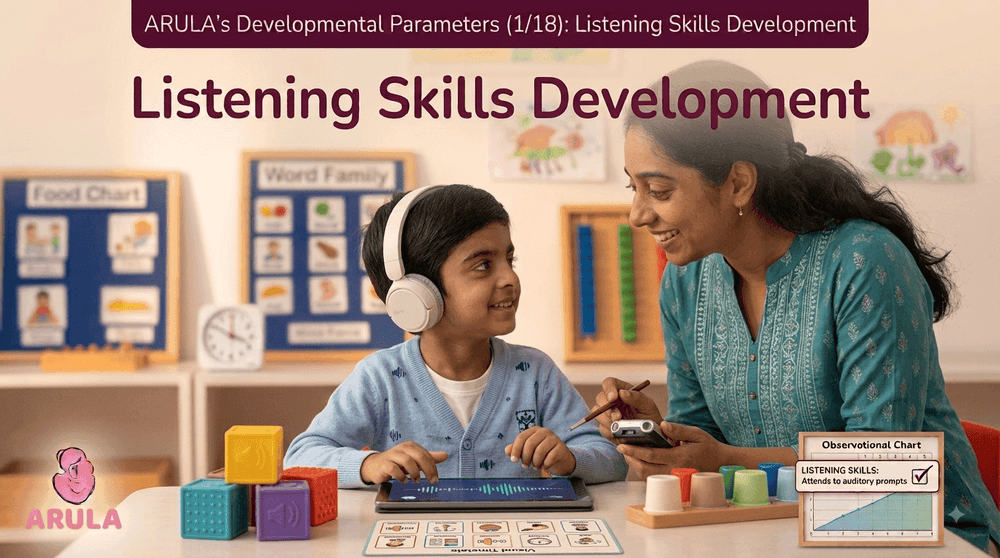
ARULA’s Developmental Parameters (1/18): Listening Skills Development
For autistic children, differences in auditory processing can impact their communication, learning, and social interaction. This article explores the critical role of listening skills in child development and how ARULA’s auditory-focused approach supports this essential area.
AF
ARULA for Autism
· 6 min read
Why Listening—Not Just Hearing—Shapes Your Child’s Growth
Listening is far more than the act of hearing. It is a foundational developmental skill that influences communication, learning, emotional regulation, and social connection. Many autistic children experience differences in how they process and tolerate auditory information, which is why listening development becomes a primary pillar of ARULA’s mother-led, auditory-focused model. By strengthening listening skills early, we create the conditions for meaningful developmental progress.
This article explains what listening truly involves, how the brain supports listening, and why improving listening skills profoundly affects a child’s growth. Research-backed explanations and open-source citations are included throughout.
What Are Listening Skills? Understanding the Full Picture
Listening is often confused with hearing, but the two are not the same. Hearing refers only to the detection of sound by the auditory system. Listening, however, involves attention, interpretation, comprehension, executive functioning, and emotional regulation.
Many children, including those on the autism spectrum, may hear sounds perfectly well while still struggling to listen, respond, or process information. Listening requires the brain to organize sound into meaningful patterns and connect them to context. This is why some children respond inconsistently when their name is called, or why they may seem to “ignore” instructions even when their hearing is normal.
Listening development also depends on emotional safety and regulation. A child who is overwhelmed, anxious, or dysregulated may be unable to access higher-level processing, even if they can hear the sounds clearly. Supporting listening therefore requires addressing both cognitive processing and nervous system readiness.
1. Hearing: Detecting Sound
Hearing is the starting point of listening. It involves the mechanical and neurological detection of sound waves through the ear and auditory nerve. Some children may demonstrate strong reactions to certain sounds, such as covering their ears or becoming distressed with loud noises. Others may appear unbothered or unusually indifferent to environmental sounds.
These differences do not necessarily indicate hearing loss; they often reflect variations in sensory thresholds or auditory filtering. Research shows that children with autism frequently experience atypical sensory processing, which may cause either hyper-sensitivity or under-responsiveness to sound (Marco et al., 2011).
Understanding a child’s hearing reactions helps us determine how to support listening readiness. For instance, children who are sound-sensitive may require gradual desensitization and emotional anchoring through the caregiver’s voice, while those who seem indifferent may benefit from heightened prosody and multisensory cues to capture attention.
2. Understanding and Processing Sound
Once a sound is heard, the brain must interpret it. This involves the auditory cortex, Wernicke’s area, and portions of the prefrontal cortex responsible for sequencing and working memory. Understanding and processing sounds requires the brain to filter relevant from irrelevant input, assign meaning, and prepare a response.
Many children who struggle in this area hear speech but have difficulty understanding it. They may recognize familiar sounds yet struggle with rapid speech, multi-step instructions, or abstract language. These difficulties often reflect challenges in auditory discrimination or the speed at which the brain processes sound.
Research in auditory processing shows that autistic children often have delayed neural responses to speech sounds, which can affect comprehension and social communication (Downs & Smith, 2018). Strengthening this skill helps the child build language from a more stable perceptual foundation.
3. Comprehension: Making Sense of Words
Comprehension moves beyond processing individual sounds to understanding meaning, relationships, and context. A child who comprehends well can follow instructions, link words to actions, and understand familiar routines.
Some children may comprehend single-step directions, like “come here,” but struggle with multi-step tasks such as “go to your room and bring your shoes.” Others may understand literal language but struggle with variations in tone, subtle cues, or emotional implications.
Improving comprehension often requires simplifying language, using consistent phrasing, and pairing words with actions. Research shows that caregiver responsiveness and clear, contingent speech strongly predict improvements in language comprehension (Sussman, 2012). ARULA’s auditory-based approach emphasizes predictable verbal routines that help children build comprehension gradually and confidently.
4. Auditory Tolerance: Staying Regulated While Listening
Auditory tolerance refers to a child’s ability to remain present, calm, and engaged while processing sound. A child with low auditory tolerance may look away, leave the area, cover their ears, or show signs of distress. Conversely, a child with higher tolerance can remain connected and continue participating even in challenging auditory environments.
This skill is closely tied to emotional and sensory regulation. According to studies on sensory processing in autism, many children struggle with auditory overload or difficulty filtering background noise, which can lead to avoidance behaviors (O’Connor, 2012).
Building auditory tolerance requires addressing both sensory and emotional components. ARULA focuses heavily on co-regulation through the caregiver’s voice, because warmth, consistency, and prosodic speech help stabilize the child's nervous system and increase their ability to tolerate and process sound.
What ARULA Observes When Assessing Listening Skills
During assessments and parent-coaching sessions, ARULA observes listening through natural interactions. These real-life patterns help us determine how well the child:
Interprets environmental sounds
Differentiates meaningful signals from background noise
Responds to simple cues and instructions
Remains emotionally regulated when the mother speaks
Uses auditory information to guide actions
These observations guide our intervention plan and help us identify the most effective strategies for the child’s unique auditory profile.
The Neuropsychological Foundation of Listening
Listening is an executive-auditory phenomenon requiring multiple cognitive systems to work together. This includes working memory (holding auditory information), attention (focusing on relevant sounds), sequencing (understanding order), and emotional regulation (staying calm enough to process input).
Neuroscientific research highlights that children with autism may show differences in auditory-limbic connections, affecting both processing and emotional responses to sound (Marco et al., 2011). Strengthening listening, therefore, requires supporting both brain-based processing and the regulation of the autonomic nervous system.
This is why ARULA begins with calming strategies, maternal prosody, and attunement before expecting significant changes in comprehension or verbal expression.
Why Listening Skills Matter for Development
Strong listening skills create a foundation for multiple developmental domains:
Speech and Language
A child cannot learn language effectively without listening readiness. Early listening improvements often correlate with gains in vocabulary, imitation, and expressive speech.
Social Communication
Listening supports joint attention, turn-taking, and understanding social cues—all areas that are often challenging for autistic children.
Emotional Regulation
Children who can tolerate sound and remain regulated tend to show fewer behavioral difficulties during transitions, instructions, or social situations.
Learning and Classroom Readiness
Listening is essential for following routines, engaging in group activities, and participating meaningfully in educational settings.
Examples of Positive Changes When Listening Improves
When listening skills improve, parents often notice:
More consistent response to name
Increased attention during play
Better understanding of simple and complex instructions
Lower sensitivity to sounds that were previously overwhelming
Rapid improvements in expressive language once comprehension stabilizes
Stronger emotional bonding through the mother’s voice
Several of these changes reflect the developmental cascade described in neurodevelopmental research: when early regulatory and auditory systems improve, downstream improvements in communication and behavior follow naturally (Feldman, 2017).
How ARULA Strengthens Listening Skills (Mother-Led Method)
ARULA’s approach is intentionally auditory-first. This means we emphasize the mother’s voice and natural interaction patterns to build listening foundations.
Prosodic Voice
A warm, rhythmic, predictable tone helps activate the child’s social engagement system, making listening easier and less stressful.
Structured Verbal Routines
Short, repetitive phrases allow the child to encounter the same auditory patterns consistently, supporting sequencing and comprehension.
Co-Regulation Framework
By helping the child regulate their nervous system through voice and presence, ARULA ensures that listening takes place within a calm, receptive state.
Gradual Auditory Exposure
Children who are sound-sensitive benefit from step-by-step exposure paired with emotional safety and anchoring.
Emotional Anchoring Through Voice
Research shows that a familiar caregiver’s voice increases oxytocin, stabilizes heart rate, and lowers stress—elements that directly support listening readiness (Feldman, 2017).